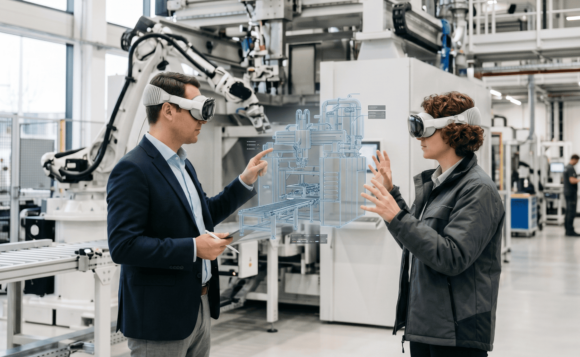
Next-generation Extended Reality tech is raising the standard for industrial 3D visualization. Complex equipment becomes much easier to show customers and walk them through, without hauling a physical unit to every meeting. For industrial machinery manufacturers, that’s real business value: by reducing their dependency on physical equipment, companies can improve sales demonstrations and make customer education more visual, scalable, and effective. The value is clear at trade fairs. Industrial machinery manufacturers can usually show only one machine in one configuration. On top of that, the most important parts are often hidden inside, and the product is displayed without the environment it was designed for. So the exhibitor arrives at the show unable to demonstrate the product they’re selling. This is where a new generation of Virtual Showrooms comes in. We’ll look at how it solves that problem below. The problems manufacturers face at trade shows But first, let’s look at the main challenges manufacturers face when relying on traditional trade show methods. The product does not fit. What a manufacturer sells is often far too big for any booth. A single production line can fill half a plant, and one machine can weigh five tons. But the trade show offers thirty square meters of rented floor at a high price. Exhibit space is the single largest line in the entire exhibiting budget: for U.S. B2B shows it accounts for 40.5% of an exhibitor’s total spend, more than any other category. At Hannover Messe (Germany), a modest 18 to 36 square meter stand costs €18,000 to €45,000, and a large one, 72 to 200 square meters, can pass €250,000. The equipment was never built to be lifted onto a stand, so a company pays the highest price in its budget for the one thing that still cannot hold the product it came to sell. Shipping machinery is expensive. The heavier the machinery, the higher the sales costs. Transportation, on-site assembling, and travel expenses can run into six figures per event. On average, construction, logistics and assembly add up to around €100,000 to get a single product onto the floor, and the largest, most impressive machines, the ones a company most wants buyers to see, are precisely the ones that push that figure highest. Buyers see a sample, not the range. Manufacturers have to choose which models to bring, and buyers never see the full portfolio. They are also limited by demo capabilities: system flow, scale, and engineering remain hidden. The value is hidden under the housing. Much of what a manufacturer charges for happens inside the machine, out of sight. Visitors stand in front of a closed housing and see only the outside of a product whose real engineering is sealed away. There is no context. Buyers need to understand how it fits into their own production line, works with existing equipment, and supports their process. That context cannot be brought to the booth, so much of the product’s value has to be imagined. The product may not exist yet. Sometimes the product a company needs to sell is still on the roadmap, or only half-built in a workshop. Industrial sales cycles are long, and buyers often need to commit before a machine physically exists. You are competing for the same buyer as everyone else. A trade show gathers the entire industry into one hall, which means every rival is only a few steps away. At IMTS 2024, visitors had to work through 1,737 exhibitors spread across more than 1.2 million square feet. Hannover Messe 2025 was larger, with 3,694 exhibitors from 62 countries and more than 123,000 visitors. In a room like that, you have to stand out to get noticed. How 3D solves each problem So, how can 3D visualization help? Problem: The product is too large to ship, or it does not exist yet. With XR, prospects can walk around a full-scale model of a product, explore different options for an engineered-to-order build, and see exactly what they are buying months before the first unit is produced. This can shorten the sales cycle. The format changes, but the product remains in front of the customer. Problem: Shipping and floor space eat the largest share of the budget. Extended Reality replaces the heaviest line items in the industrial sales budget with a single portable asset. Each of the costs for equipment transport, exhibition stand rental, assembly crew, technical team travel recurs with every event. Over a year, they compound into one of the largest budget lines in industrial sales. A 3D model is created once and can be presented on a screen, in AR, or in VR using equipment that occupies only a small part of the stand. It can be updated when the product line changes and redeployed without additional logistics. Problem: A physical demo can show only one configuration. Let each visitor build their own version. For configurable machines built to order, each customer can preview their exact configuration in detail rather than a generic prototype. A configurator on a touchscreen, or the same system in AR or VR, lets them choose components and options, see the result update instantly, and leave with a build that matches their plant. One asset covers all two hundred configurations in the catalog. Problem: The most important parts of the product are hidden inside. Exploded views, cutaways and animations show what happens beneath the surface. On a screen, a visitor grasps how the system works within seconds; in AR or VR, they can pull it apart and study the internals in detail. Problem: Buyers can’t easily picture how the product fits their own plant. VR can put a buyer inside a virtual production line. AR can drop the equipment at full scale into the room right in front of them, so they can walk around it. This way, they can see how it fits their facility instead of guessing. Problem: You have a few minutes to catch attention, and competitors are right next to you. Big screens with motion are…