Introduction
The World of Artificial Intelligence (AI) and Its Application in Content Creation for RPG Games
Recently, the world of IT technology has been actively filled with various iterations of artificial intelligence. From advanced chatbots that provide technical support to complex algorithms aiding doctors in disease diagnosis, AI’s presence is increasingly felt. In a few years, it might be hard to imagine our daily activities without artificial intelligence, especially in the IT sector.
Let’s focus on generative artificial intelligence, such as TensorFlow, PyTorch, and others, which have long held an important place in software development. However, special attention should be given to the application of AI in the video game industry. We see AI being used from voice generation to real-time responses. Admittedly, this area is not yet so developed as to be widely implemented in commercially available games.
But the main emphasis I want to make is on the creation and enhancement of game content using AI. In my opinion, this is the most promising and useful direction for game developers.
The Lack of Resources in Creating Large and Ambitious RPG Games and How AI Can Be a Solution
In the world of indie game development, a field with which I am closely familiar, the scarcity of resources, especially time and money, is always a foremost challenge. While artificial intelligence (AI) cannot yet generate money or add extra hours to the day (heh-heh), it can be the key to effectively addressing some of these issues.
Realism here is crucial. We understand that AI cannot write an engaging story or develop unique gameplay mechanics – these aspects remain the domain of humans (yes, game designers and other creators can breathe easy for now). However, where AI can truly excel is in generating various items, enhancing ideas, writing coherent texts, correcting errors, and similar tasks. With such capabilities, AI can significantly boost the productivity of each member of an indie team, freeing up time for more creative and unique tasks, from content generation to quest structuring.
What is Artificial Intelligence and How Can it be Used in Game Development
For effective use of AI in game development, a deep understanding of its working principles is essential. Artificial intelligence is primarily based on complex mathematical models and algorithms that enable machines to learn, analyze data, and make decisions based on this data. This could be machine learning, where algorithms learn from data over time becoming more accurate and efficient, or deep learning, which uses neural networks to mimic the human brain.
Let’s examine the main types of AI
- Narrative AI (OpenAI ChatGPT, Google BERT): Capable of generating stories, dialogues, and scripts. Suitable for creating the foundations of the game world and dialogues.
- Analytical AI (IBM Watson, Palantir Technologies): Focuses on data collection and analysis. Used for optimizing game processes and balance.
- Creative AI (Adobe Photoshop’s Neural Filters, Runway ML): Able to create visual content such as textures, character models, and environments.
- Generative AI (OpenAI DALL-E, GPT-3 and GPT-4 from OpenAI): Ideal for generating unique names, item descriptions, quest variability, and other content.
By understanding the strengths and weaknesses of each type of AI, developers can use them more effectively in their work. For example, using AI to generate original stories or quests can be challenging, but using it for correcting grammatical errors or generating unique names and item descriptions is more realistic and beneficial. This allows content creators to focus on more creative aspects of development, optimizing their time and resources.
An Overview of the Characteristics of Large Fantasy RPG Games and Their Content Requirements
In large fantasy RPG games, not only gameplay and concept play a pivotal role, but also the richness and variability of content – spells, quests, items, etc. This diversity encourages players to immerse themselves in the game world, sometimes spending hundreds of hours exploring every nook and cranny. The quantity of this content is important, but so is its quality.
Imagine, we offer the player a relic named “Great Heart” with over 100 attribute variations – that’s one approach. But if we offer 100 different relics, each with a unique name and 3-4 variations in description, the player’s experience is significantly different. In AAA projects, the quality of content is usually high, with hundreds of thousands of hours invested in creating items, stories, and worlds. However, in the indie sector, the situation is different: there’s a limited number of items, less variability – unless we talk about roguelikes, where world and item generation are used.
A typical feature of roguelikes is the randomization of item attributes. However, they rarely offer unique generation of names or descriptions; if they do, it’s more about applying formulas and substitution rules, rather than AI. This opens new possibilities for the use of artificial intelligence – not just as a means of generating random attributes, but also in creating deep, unique stories, characters, and worlds, adding a new dimension to games.
Integrating AI for Item Generation: How AI Can Assist in Creating Unique Items (Clothing, Weapons, Consumables).
One of the practical examples of using AI is creating variations based on existing criteria. Why do I consider this the best way to utilize AI? Firstly, having written the story of your game world, we can set limits for the AI, providing clear input and output data. This ensures a 100% predictable outcome from AI. Let’s examine this more closely.
When talking about the world’s story, I mean a few pages that describe the world, its nature, and rules. It could be fantasy, sci-fi, with examples of names, unique terminology, or characteristic features that help AI understand the mood and specifics of the world. Here is an excerpt from the text I wrote for my game world.
The Kingdom of Arteria is an ancient and mysterious realm, shrouded in secrets and imbued with a powerful form of dark magic. For centuries, it has been ruled by Arteon the First, a wise and just monarch whose benevolence has brought peace and prosperity to his people. It is said that Arteon the First ascended the throne one thousand years ago and that his reign has continued to this day through the strength of his will and his dedication to protecting the kingdom from its enemies.Regarding other clear instructions for AI, it’s crucial to make it understand what the input data is, what it means, and how to use it. Negative instructions are also important – things that shouldn’t be used or avoided. Here is an example of a description of input data and instructions for AI.
Generate creative item names and descriptions for a fantasy RPG game based on user-provided inputs. For example, given 'Bandit [Belt, Default, Blue]', output a structured response including item type, a unique name, and a short, imaginative description that fits a fantasy game setting. Ensure the description is engaging, adding history or mystery to the items, and enhancing the game's narrative feel. Keep descriptions between 2-25 words. The tone should be helpful, creative, and whimsical, in line with a fantasy RPG game, providing concise and detailed responses that make each item feel unique and integrated into the fantasy world.Another important aspect is indicating to AI what output data we expect. This is vital in content generation, as we don’t want to manually copy data but want it to be automatically integrated through code. Therefore, we must clearly write this in the instructions to AI. Here is an example that I use.
Avoid content that is overly modern, breaks the fantasy setting, or is inappropriate. Stay imaginative yet coherent with typical fantasy themes. If an input is vague, creatively fill in gaps while adhering to the fantasy theme, but do not deviate far from the user's input. The focus should be on maintaining the integrity of the fantasy RPG game's setting, ensuring each item name and description respects the genre's conventions and enhances the overall narrative experience.Using this information, we can test it through Chat GPT-3.5 or Open API, details of which we will discuss in the next section. Below, you can see the output that Chat GPT-3.5 gives us.
Utilizing Open API: Unveiling How Open API Can Be Used for Generating Names, Descriptions, and Properties of Items
In the previous section, we discussed using positive and negative prompts for chat. Now, let’s delve into the details of integrating AI into a game, specifically with Unity. This will be a sort of masterclass in incorporating AI into a live project.
Creating a Database of Ready-Made Items
With a game on Unity, our goal is to facilitate the work of content creators. We understand that real-time generation is possible but not in our case. Therefore, we need to create a database of ready-made items. To do this, we’ll develop a Unity Editor Script that will implement a tool for creating unlimited variability of items from basic elements.
Item Data Model
Let’s consider our basic data model:
ItemDataModel {
    Name: String,        // Name of the item (e.g., "Excalibur", "Shadow Robe")
    Description: String, // Description of the item (e.g., "A legendary sword of unsurpassed power.")
    Type: String,        // Type of the item (e.g., "Hands", "Pants", "Chest")
    Rarity: String,      // Rarity level of the item (e.g., "Trash", "Common", "Uncommon", "Rare")
    Level: Int,          // Level requirement to use the item (e.g., 1, 2, 3)
    Stats: {             // Statistical bonuses provided by the item
        Strength: Int,   // Bonus to strength
        Agility: Int,    // Bonus to agility
        Intellect: Int,  // Bonus to intellect
        Faith: Int,      // Bonus to faith
        Stamina: Int,    // Bonus to stamina
        Armour: Int      // Armour rating
    },
    Resistance: {        // Resistance bonuses provided by the item
        Nature: Int,     // Resistance to nature-based attacks
        Void: Int,       // Resistance to void-based attacks
        Fire: Int,       // Resistance to fire-based attacks
        Frost: Int       // Resistance to frost-based attacks
    }
}
This is a classic dataset for RPGs, where values for all numerical fields are set using a randomizer. Our main focus is on the Name and Description fields.
Extended Prompt for AI
To our prompt, we add additional data from the model, creating a detailed request:
Item type is {ItemDataModel.Type}, rarity level is {ItemDataModel.Rarity}, in the game world item level is {ItemDataModel.Level} of max level {World.MaxItemLevel}.
This item has stats:
- Strength: {ItemDataModel.Stats.Strength}
- Agility: {ItemDataModel.Stats.Agility}
- Intellect: {ItemDataModel.Stats.Intellect}
- Faith: {ItemDataModel.Stats.Faith}
- Stamina: {ItemDataModel.Stats.Stamina}
- Armour: {ItemDataModel.Stats.Armour}

This item has resistance:

- Nature: {ItemDataModel.Resistance.Nature}
- Void: {ItemDataModel.Resistance.Void}
- Fire: {ItemDataModel.Resistance.Fire}
- Frost: {ItemDataModel.Resistance.Frost}
This allows the creation of items with unique names and descriptions, appropriate to their characteristics.
Integration with OpenAI
For integration with OpenAI, we formulate a request through the Unity API. You can find the request details on the official OpenAI website.
// Defines a client class for interacting with the OpenAI ChatGPT API.
public class OpenAIChatGPTClient
{
    // Private field to store the API key.
    private readonly string apiKey = "*************";

    // API endpoint URL for the ChatGPT service.
    private readonly string apiEndpoint = "https://api.openai.com/v1/chat/completions";

    // HttpClient instance for making HTTP requests.
    private readonly HttpClient httpClient;

    // Constructor for the OpenAIChatGPTClient class.
    public OpenAIChatGPTClient()
    {
        // Initialize the HttpClient object.
        httpClient = new HttpClient();
    }

    // Asynchronous method to send a chat request to the OpenAI API.
    public async Task RequestChatResponse(string name, string stats, string resistance)
    {
        // Prepare the request data in an anonymous object format.
        var requestData = new
        {
            model = "gpt-3.5-turbo-1106",
            response_format = new { type = "json_object" },
            messages = new[]
            {
                new { role = "system", content = "Positive and negative prompt and output details. Output should be ONLY JSON with \"Name\" and \"Description\" label" },
                new { role = "user", content = $"{name}, stats:{stats}, resistance:{resistance}" }
            }
        };

        // Serialize the request data to JSON format.
        var requestJson = JsonConvert.SerializeObject(requestData);

        // Call the SendRequest method to execute the API request.
        return await SendRequest(apiEndpoint, requestJson);
    }

    // Private asynchronous method to send a JSON payload to the specified URL.
    private async Task SendRequest(string url, string jsonPayload)
    {
        // Create a StringContent object with the JSON payload.
        var content = new StringContent(jsonPayload, Encoding.UTF8, "application/json");

        // Set the authorization header for the HTTP client.
        httpClient.DefaultRequestHeaders.Authorization = new System.Net.Http.Headers.AuthenticationHeaderValue("Bearer", apiKey);

        try
        {
            // Send the POST request and get the response.
            var response = await httpClient.PostAsync(url, content);

            // Ensure the response status code indicates success.
            response.EnsureSuccessStatusCode();

            // Read and return the response content as a string.
            return await response.Content.ReadAsStringAsync();
        }
        catch (Exception ex)
        {
            // Log the error if the HTTP request fails.
            Debug.LogError("Error in HTTP request: " + ex.Message);
            return null;
        }
    }

    // Method to parse the JSON response string and extract item details.
    public ItemDetails ParseResponse(string jsonString)
    {
        try
        {
            // Deserialize the JSON string to a ChatResponse object.
            var chatResponse = JsonConvert.DeserializeObject(jsonString);

            // Extract the content from the first choice in the response.
            var content = chatResponse.Choices[0].Message.Content;

            // Deserialize the content JSON string to an ItemDetails object.
            var itemDetails = JsonConvert.DeserializeObject(content);
            return itemDetails;
        }
        catch (JsonException e)
        {
            // Log an error if JSON parsing fails.
            Debug.LogError("JSON parsing error: " + e.Message);
            return null;
        }
    }

    // Nested class representing the structure of the chat response.
    public class ChatResponse
    {
        public List Choices { get; set; }
    }

    // Nested class representing a choice in the chat response.
    public class Choice
    {
        public Message Message { get; set; }
    }

    // Nested class representing the message part of a choice.
    public class Message
    {
        public string Content { get; set; }
    }

    // Nested class to hold the details of an item (name and description).
    public class ItemDetails
    {
        public string Name { get; set; }
        public string Description { get; set; }
    }
}
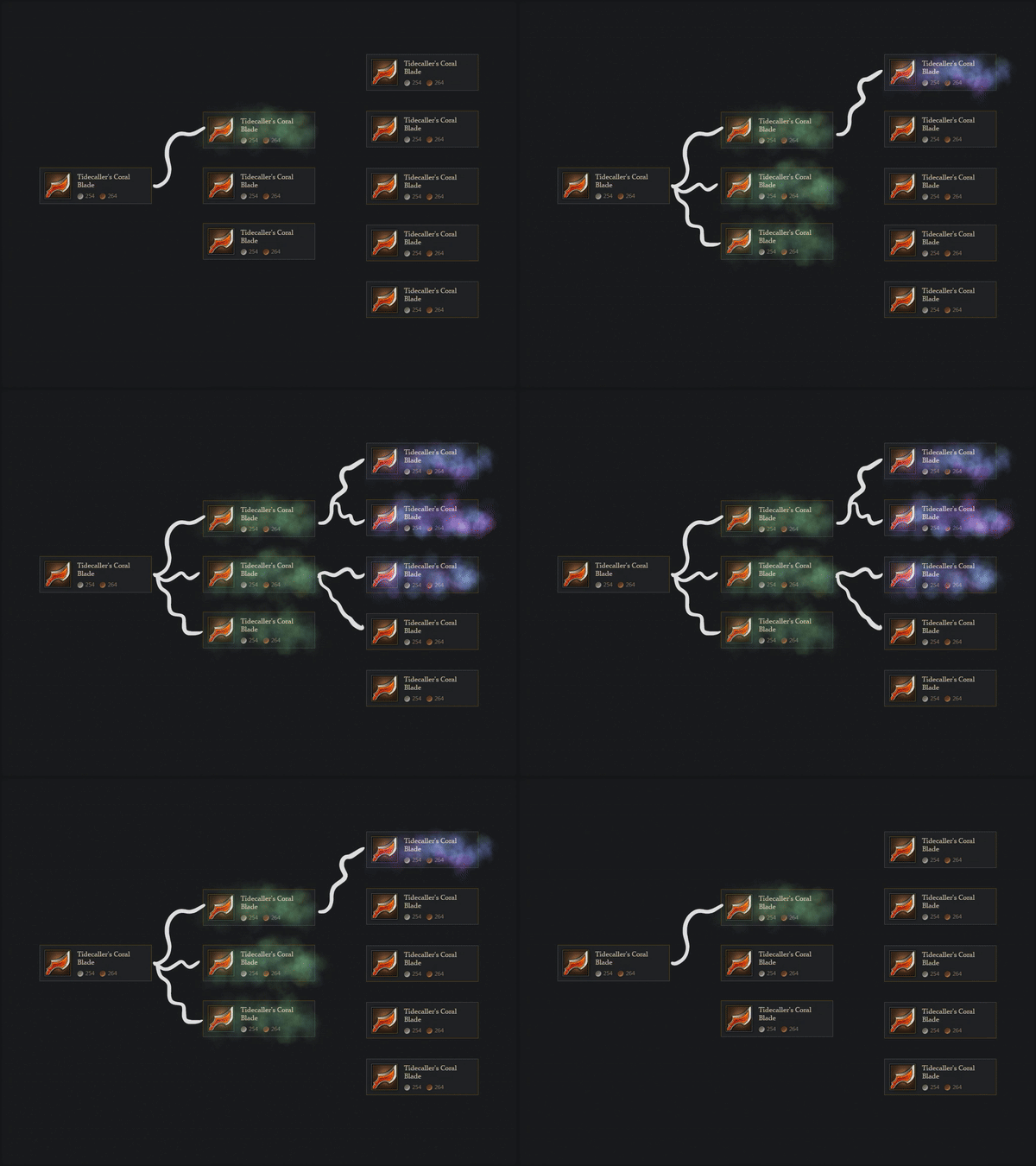
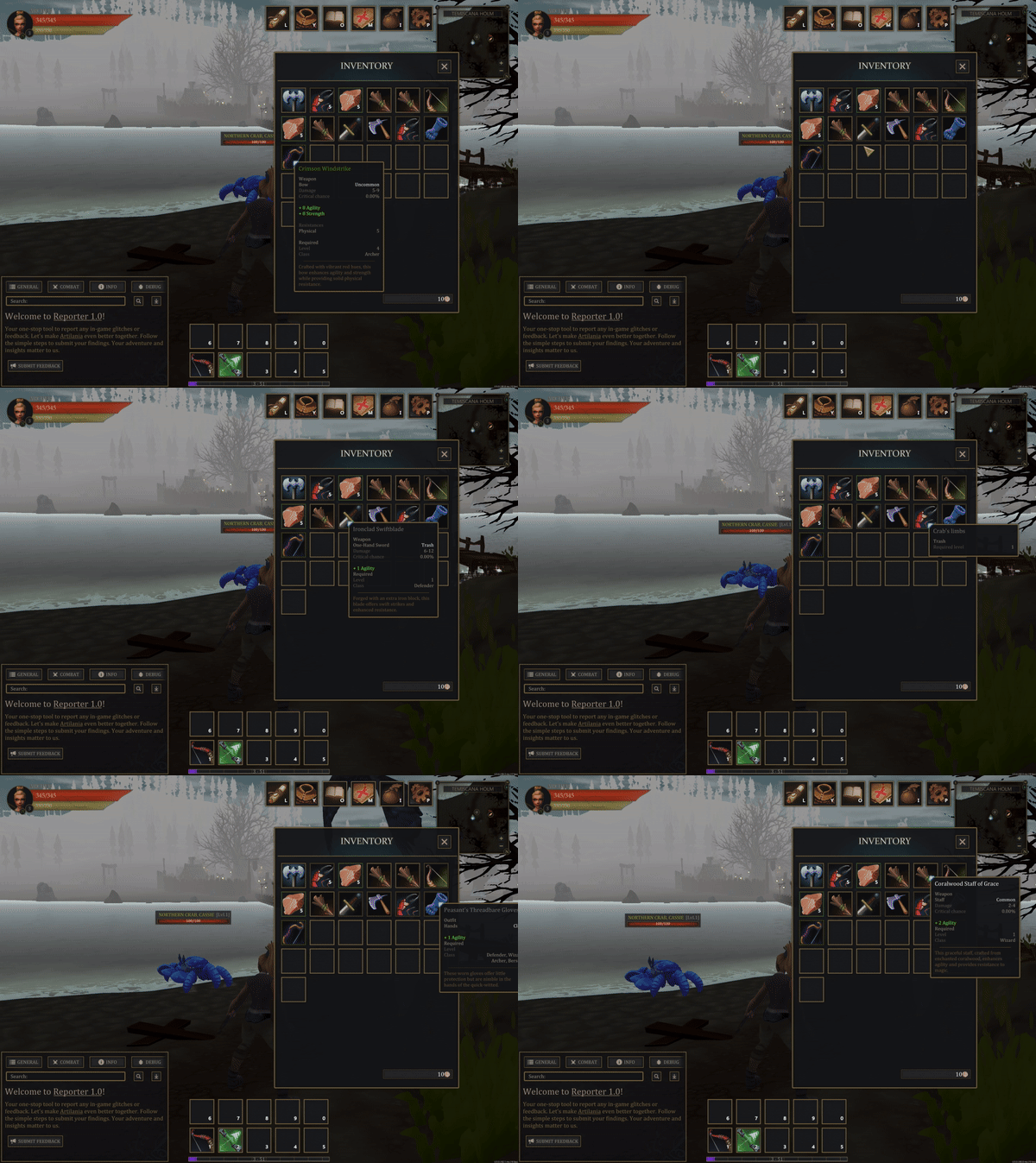
Having received a response from AI, we parse it (using UnityJsonUtility) and insert the data into our ItemDataModel. Thus, in a matter of minutes, we can generate thousands of items with unique names and characteristics.

Examples of AI Results
| Name | Tidecaller’s Coral Blade | Coral Tidal Dagger | Crimson Tide Stiletto | Abyssal Serpent Fang | Aqua Shard Dagger |
| Description | This dagger, crafted from enchanted coral, channels the power of the ocean, enhancing the wielder’s faith and intelligence while providing moderate armor. | This dagger’s wave-like blade, crafted from enchanted coral, grants protection against frozen spells and void magic. | This sleek dagger’s blade ripples like the unforgiving waves, empowering swift and agile strikes. | This dagger’s rippling blade evokes the power of the deep sea, granting agility and formidable resistance to fire and void magic. | Forged from the depths of the ocean, this dagger’s wave-like blade enhances agility and evokes the power of water. |
| Stats | |||||
| Armour | 7 | 6 | |||
| Faith | 10 | N/A | 4 | N/A | N/A |
| Intelligence | 10 | N/A | 1 | N/A | 3 |
| Strength | 5 | N/A | N/A | N/A | N/A |
| Stamina | N/A | N/A | 6 | N/A | N/A |
| Agility | N/A | N/A | 9 | 1 | 10 |
| Resistances | |||||
| Frozen | N/A | 8 | N/A | N/A | N/A |
| Void | N/A | 24 | N/A | 35 | N/A |
| Fire | N/A | N/A | N/A | 15 | N/A |
Case Study
Practical Examples
Searching the internet, one can find numerous examples of AI use in major gaming projects. Here are a few examples and references where AI has already been effectively utilized.
World and Content
“Microsoft Flight Simulator” employs AI to create a detailed replica of the real world, including over 1.5 billion buildings. This is an example of how AI can replace hundreds of thousands of hours of manual labor, creating incredibly detailed scenarios.

This game showcases AI’s capability to process and integrate vast amounts of geographical data and imagery, transforming them into an immersive and realistic virtual environment. This not only enhances the gaming experience by providing realistic landscapes and cityscapes but also demonstrates the efficiency and scalability of AI in handling complex and large-scale content creation tasks.
The application of AI in “Microsoft Flight Simulator” serves as a benchmark in the gaming industry, illustrating the potential of AI to revolutionize content creation in RPGs and other genres, where detailed
and expansive game worlds are integral to the player experience. This example underscores the transformative impact that AI can have in the gaming industry, not just in terms of enhancing existing processes but also in opening new avenues for creative and expansive world-building.
Voice and Dialogues
In “NetEase’s Cygnus Enterprises,” AI is used to create NPCs capable of engaging in natural and meaningful dialogue with the player, reacting to their actions in the game. This demonstrates how AI can expand game mechanics, making them deeper and more interactive.

Other Examples of AI Application in Video Games
Aeon Odyssey: This project uses AI to generate large and complex galaxies. Similar to “Microsoft Flight Simulator,” the game creates a sense of a living and dynamic universe. This is crucial for gameplay where the world itself is a key element.
Quantum Quandary: This game employs AI to create puzzles that adapt to the player’s skills. Tasks that would take thousands of hours for human developers to create, AI generates in a matter of hours, offering a significant advantage.
These examples illustrate how AI can influence game design by creating unique game worlds and adaptive mechanics that enhance player capabilities and create a more engaging experience.
AI-Based Tools for Game Developers
Promethean AI and Ludo.ai: These systems automate the game creation process, from prototyping to level design. They enable developers to quickly and efficiently bring their ideas to life, reducing the need for manual labor.
Rosebud.ai: This tool uses AI to create 3D worlds, objects, and textures according to user-specified criteria. It provides great flexibility and creativity in the design of game elements.
Layer.ai: Offers comprehensive solutions for enhancing AI-generated games, including prototyping mechanics, level generation, sound implementation, and visualization. This helps create more polished and professionally looking games.

These tools demonstrate how AI is transforming the gaming industry, opening new horizons for game designers and content creators. They allow for the creation of deeper and more interactive gaming experiences, significantly expanding the possibilities in creating unique and captivating games.
Conclusion
The Future of Game Development with AI: Key Advantages and Potential
In this article, we have discussed the importance of artificial intelligence (AI) in the development of RPG games and its impact on game development. Through examples of various AI technologies and tools, we have examined how intelligent systems can solve a range of problems in the gaming industry, offering significant benefits for developers.
Innovative Approach to Content
The use of AI to generate unique content such as items, dialogues, and stories opens new possibilities for creating deeper and more engaging gaming worlds. This approach not only saves time and resources for developers but also enhances the level of individuality in the gaming experience for each player.
Optimization of Resources and Efficiency
AI enables indie developers to efficiently optimize their limited resources. From generating a large amount of content to assisting in balancing game elements, AI becomes an indispensable assistant, allowing focus on more creative aspects of development.
Expanding Capabilities for Game Designers
AI offers new tools and techniques for game designers, allowing them to realize their most ambitious ideas. From creating complex worlds to developing unique game mechanics, AI opens new horizons for creativity.
Interactivity and Depth of Gaming Experience
Integrating AI into gameplay provides new levels of interactivity and depth in the gaming experience. From realistic NPCs to dynamic changes in the game world, AI can create a more immersive and engaging environment for players.
Future Potential of AI in Game Development
AI has the potential to fundamentally change the gaming industry, offering new opportunities for innovation and creativity. With increasing accessibility and the advancement of technologies, we can expect even more exciting and revolutionary changes in the way games are created and played.
The future of AI in game development holds immense promise, heralding a new era where the boundaries of creativity and technology blend seamlessly to create gaming experiences that are not only innovative but also deeply personal and engaging for each player. This convergence of AI with game development is not just a glimpse into the future of gaming but a testament to the endless possibilities that AI brings to the creative world.

Latest Articles