Exploring Spatial Computing and Its Impact on Industries

Spatial computing is a fast-growing field that is set to create a new way of interacting with the world around us. This technology has the potential to revolutionize many industries, from healthcare and education to manufacturing and more. The potential is seen by such well-known companies as Apple, Meta, Magic Leap, and others, which work with spatial computing and mixed, augmented, and virtual reality. By 2032, the total value of the spatial computing market will grow to more than $512 billion, compared to $87.5 billion in 2022.

In this article, we will take a closer look at the concept of spatial computing and try to explain how it differs from mixed reality, as well as its potential impact on various industries. 

Rise of Spatial Computing.  Historical Overview

According to Wikipedia, the term “spatial computing” was first coined in 2003, in the eponymous research paper by Simon Greenwold, a former researcher in the Aesthetics and Computation group at the MIT Media Lab and current head of Story As… Simon Greenwald. The original definition of spatial computing is “a human-machine interaction in which the machine retains and manipulates referents to real objects and spaces”.

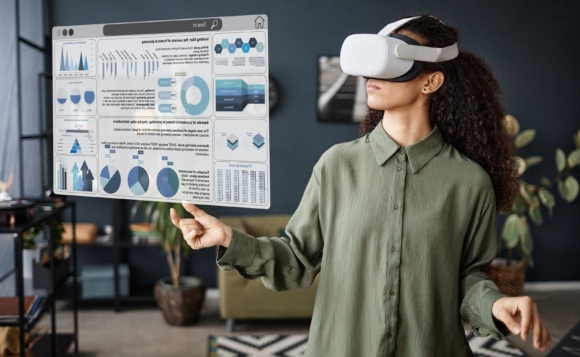
With the development of immersive technologies, modern spatial computing primarily describes a direct human interaction with technologies and digital content. For example, spatial computing involves the use of gestures, head and eye movements, voice commands and their integration into the digital interface of a device, such as the latest Apple Vision Pro.

As defined by Apple, spatial computing is a technology that seamlessly blends digital content with the real world. For example, this technology is useful for remote work, games, or movies, where a headset user can expand the screen to gigantic dimensions, making home viewing more like a real cinema experience.

Spatial Computing vs. Mixed Reality. Understanding Key Differences

There is a popular opinion that the term “spatial computing” is not so innovative. According to some experts, this technology works on the principle of mixed reality, popularized by Microsoft with the help of Hololens MR glasses. And indeed, according to Vladimir Grygoriev, Qualium Systems tech lead, both mixed reality and spatial computing impose digital objects on the real space, considering the physics of the space.

“In fact, many devices already do the same spatial mapping as Apple does. And what is Apple planning to present, what is the main innovation and the difference? First, they want to add such image quality that a person will not feel the artificiality of it on devices. Meaning, you have a cup standing in front of you, and when being touched, it falls, spills, and breaks. But when you take off your glasses, it does not even exist,” Grygoriev said.

On the other hand, when releasing the newest headset, Apple plans to use “spatial computing” as a collective term for other areas, such as spatial rendering, spatial mapping, spatial interactions, etc. The innovation of Vision Pro is also about its functionality, with the interface allowing you to turn on several applications at the same time.

“Apple will provide an option, that allows you to run a bunch of applications in small windows in your room. It will also give other people access to your space. You can make 5–10 different screens, where various types of content are being sheared. Then you can close some apps and, wearing a headset, go from the dining room to the kitchen while checking your online chat,” Grygoriev said.

Implementing Spatial Computing and Mixed Reality

Spatial computing is used in such areas as

  • 3D Modeling. Due to the fact that spatial computing technology can seamlessly integrate digital objects into real space, a user of an AR/VR headset can design a 3D model of their future project, whether it is a building, a car, a room, etc. With spatial computing, a user has the ability to zoom in and out a digital object, view it from all sides, etc. This gives the user the opportunity to see the future construction in more detail and correct errors that can cause serious financial losses. For example, in this video, an engineer wearing Hololens 2 glasses projects a future car model on his desk.

  • Remote collaboration. With spatial computing and mixed reality, employees who are in different places can collaborate and see each other. It can be either a completely virtual environment (for example, a virtual office) or an MR option, in which the employee can see a digital screen with the image of their colleague or his own digital avatar in XR-glasses, without leaving a physical workplace. One of the interesting cases of remote collaboration through MR is the concept of mixed reality from the Airbus airline company. The company’s employees work with customers on the aircraft’s family cabin design. The concept offers a full recreation of the virtual cabin on portable devices, as well as the possibility of collective work of MR-glasses users on a digital model of the cabin superimposed on the real world.

  • Training and skill development. Mixed reality and spatial computing have found their application for training employees in various fields. The convenience of MR training lies in the fact that the employee acquires practical skills at work with the help of digital instructions that are smoothly superimposed on the workplace. Mixed reality and spatial computing are not only implemented to train doctors and factory workers. For example, mixed reality is used to train military pilots for the F-16, F-18, and F-35 fighter jets. During training from Varjo, the pilot sits in the cockpit with a real control panel. A pilot, while training in MR glasses, sees a real image of himself in the cockpit alongside a virtual environment that reproduces the training ground.

Spatial Computing Technologies. Where and How They’re Making an Impact 

Empowering Medical Professionals: Spatial Computing’s Role

Spatial computing is already finding its application in the field of medicine. This technology allows you to create interactive digital twins of patients, so that doctors can examine the body from any angle and see a better picture of their diagnosis, more accurately select drugs and create a treatment plan. Also, digital 3D projections are actively used both during surgical interventions and during training. 

For example, the Lynx company, in collaboration with the research center INSERM, created a mixed reality program for training medics and conducting surgeries. Thus, surgeons in MR headsets can visualize a patient’s organ they are going to operate on before and during the procedure itself, calculating all possible risks and consequences. The doctor can also add scans of the patient’s real organs and data from their medical record to provide a more realistic experience. During the operation, the doctor in MR glasses is able to monitor the processes in the patient’s body in real time and manipulate digital content using hand gestures.

How Spatial Computing Enhances Architectural Processes

With spatial computing, architects and designers can create interactive presentations. Such presentations can reassure the client in a more efficient way and show them how the final product will look. In this way, it is possible to present the project more transparently and clearly so that a customer pays attention to the design flaws, which will be eliminated in the future.

The development of architectural projects with the help of spatial computing allows you to take into account the nuances of the future building and calculate possible design errors.

For example, the French real estate firm BNP Paribas Group, together with Magic Leap and Vectuel & RF Studio, developed “the POD”, a special capsule with virtual reality glasses,  a client enters into and puts on the glasses. In them, he sees a virtual tour with digital models of the future buildings that can be purchased, as well as a visual tutorial on purchasing real estate.

Spatial Computing’s Role in Modern Manufacturing

In manufacturing, spatial computing is used in several directions, such as virtual training, navigation, remote support, creating a digital double of the supply chain, tracking processes in the chain in real-time, etc. Thanks to spatial computing, an employee receives digital instructions that facilitate his work without leaving the workplace.

The American manufacturing company PBC Linear released an AR training for factory workers using tablets and AR glasses. The main goal of introducing the augmented reality is to reduce the training time of employees from three weeks to three days.

“The first thing we do is we record an operator running through the procedures of the machine. Whether it’s a start-up, tool touch-off, blow-off, or any sort of quality. We’ll have someone standing behind them recording and asking questions. They then take those recordings and those questions up to either their computer to author the instructions, or in front of the machine they’ll put on a HoloLens or Magic Leap and they’ll start creating those instructions, just as the tool maker operator laid out for them. And within just a few hours they’ll have a virtual reality or augmented reality version of that same training,” said Beau Wileman, the Factor of the Future Manager.

Spatial Computing Technologies. Future of Learning in Digital Age

Immersive technologies have been proven to enhance the student’s ability to learn new material and consolidate theoretical skills. According to Arbor XR, students are almost 4 times more emotionally connected to the learning material and 4 times more focused on learning.

With mixed reality and spatial computing, a traditional classroom lesson can be turned into an interesting adventure by visually showing an interactive digital model of the learned subject.

For example, the Titans of Space MR app for the Meta Quest glasses will be useful for those who study astronomy. In this app, the option of virtual tours of the digital universe with interactive models of celestial bodies is available. Students travel on a board of a spaceship and can see, for example, the digital solar system up close.

Spatial Computing Revolutionizing Advertising 

In today’s technology era, marketers and advertisers are increasingly paying attention to XR. It is confirmed that with the help of interactive content, customers become more interested in the product offered. Knowing this, 90% of companies already use or plan to introduce mixed reality in their advertising campaigns.

In October 2022, at the NFL games, Gilette created an MR ad for the stadium with a large digital model of the razor.

Spatial computing continues the development of technological innovations that blur the boundaries between the physical and digital worlds. Like virtual, augmented, and mixed reality, spatial computing is a transformative force that will carry on shaping industries for years to come. Advanced devices like Apple Vision Pro offer users a new way of interacting with digital objects that respond to the physics of the real environment. Therefore, the technologies of spatial computing and mixed reality have come in handy in such areas as manufacturing, architecture, mechanical engineering, education, etc.

Latest Articles
Digital Twins for Digital Transformation Strategy in the Industrial Sector
April 22, 2026
Digital Twins for Industry 5.0 Transformation Strategy

Industrial digital transformation is no longer just about automation or collecting data. More and more, it comes down to having a live, accurate digital representation of what is actually happening across physical operations. That is what a digital twin does: it creates a virtual model of a machine, a production line, or an entire facility, and keeps it synchronized with real-world data in real time. This makes it more than a visualization tool. It becomes a working instrument for a variety of industrial applications: simulations, predictive maintenance, monitoring and analytics, process and operational optimization, quality control, worker enablement, EHS solutions, and faster decision-making. Industrial Extended Reality (XR) and immersive technologies are entering their second wave of adoption. While the first wave was shaped mainly by experimentation with XR, the current stage is enabled by mature hardware and significantly stronger digital capabilities, allowing organizations to realize the true value of VR and AR in practical, scalable ways. In parallel, digital transformation is shifting from the automation-led, low-human-involvement logic of Industry 4.0 toward a human-centric model built on human-machine collaboration and co-piloting in Industry 5.0. Industry is adopting Extended Reality (XR) faster than any other sector. Manufacturing and industrial operations accounted for 35.1% of the global digital twin market in 2025. More than half of companies using digital twins report profitability increases of over 20%, and Gartner predicts that by 2027, 40% of large industrial companies will use the technology, resulting in increased revenue. The market overall is projected to grow from $49.2 billion in 2026 to $228.46 billion by 2031. These numbers show that digital twins become a core part of how industrial companies compete and operate. In this article, we look at the specific areas where digital twins create the most value in the industrial sector today, walk through real-world cases from companies already using them at scale, and discuss where the technology is headed next. Why Digital Twins are more than virtual models The role of digital twins has broadened significantly, now covering simulation, planning, operations, and essential 3D visualization needs. As a strategic capability, the digital twin helps organizations understand the present state of assets and systems, anticipate what comes next, and make more precise, informed decisions. This is what separates them from the technologies they are often confused with. A 3D model is static and disconnected from physical reality. A simulation runs defined scenarios but doesn’t update as circumstances change. BIM captures asset properties at a point in time—valuable, but not dynamic. A digital twin does all three, continuously. Let’s look at how this works from a technological perspective. The technology stack behind the intelligence Within the virtual model, three interconnected layers work together.  The first is the data storage and processing layer, responsible for ingesting, organizing, and structuring incoming data streams. IoT sensors and edge devices form the foundation of data acquisition, continuously capturing physical parameters: temperature, vibration, pressure, energy consumption, throughput. This data moves through real-time pipelines into processing environments. The second is the analytics and AI layer, which interprets this data by detecting anomalies, identifying patterns, generating forecasts, and providing recommendations to guide operational decisions.  The third is the visualization and interface layer, translating these insights into clear, actionable formats: dashboards, alerts, or interactive simulations, that engineers, operators, and executives can easily use. A digital twin also integrates with the broader enterprise ecosystem, including engineering documentation, GIS platforms, maintenance systems, financial tools, and business networks. The result is a closed loop of intelligence. Physical reality continuously updates the virtual mode → the model generates insights → and those insights guide decisions that impact the physical system. Types of digital twins Depending on the level of detail and the specific operational goals, a digital twin can focus on a single component, a complete asset, an entire system, or even a full process. Recognizing these distinctions helps organizations select the right model for each use case. A component twin represents a single element (a pump, a bearing, a sensor) and is primarily used for granular condition monitoring and early failure detection.  An asset twin integrates multiple components into a unified model of a complete physical asset, such as a machine or a turbine, enabling a more comprehensive view of performance and interdependencies.  A system twin extends this further, representing how multiple assets interact within a broader operational environment (a production line, a power grid, or a supply chain node).  A process twin models entire workflows and decision sequences, making it possible to trace how disruptions, inefficiencies, or interventions propagate across an organization. In real-world deployments, these levels are layered: component twins feed into asset twins, which feed into system and process twins. This nested setup mirrors actual operational complexity and enables insights at any level, from individual parts to entire workflows. Where digital twins create the most industrial value Below, we break down the use cases where digital twins are generating the most value in the industrial sector today. Predictive maintenance and asset reliability Unplanned equipment downtime remains one of the most costly scenarios for any industrial enterprise. When a critical asset fails unexpectedly, the company loses not only on repairs but also on production chain disruptions, logistical failures, and reputational risks. This is why predictive maintenance powered by digital twins has become one of the most mature and economically justified applications of the technology. The traditional approach to maintenance operates on two models: reactive (repair after failure) or scheduled preventive (servicing on a fixed schedule, regardless of the actual condition of the equipment). Both models are inefficient. The first leads to emergency shutdowns, while the second results in excessive spending on servicing components that still have significant remaining life. The digital twin changes this paradigm. It creates a virtual copy of a physical asset that continuously receives sensor data and updates in real time. Through machine learning algorithms, the system analyzes wear patterns, compares current conditions against historical data, and predicts the moment when a component will reach a critical state. This enables maintenance to…

April 2, 2026
Quality and Security You Can Trust, Proven Again: Qualium Renews ISO 27001 and 9001 Certifications

More than 2 years ago, we initiated a focused effort to elevate our security and quality frameworks. Our objective wasn’t just to satisfy standards – it was to make security an integral part of our operations, from daily workflows to strategic decisions. Leading the initiative, Dmytro Stetsenko, Co-founder and CTO at Qualium Systems, stepped up to lead the audit internally, ensuring completion of formal ISO 9001 & 27001 auditor training and reinforcing our internal capabilities. In the months that followed, he partnered with compliance experts and process owners to enhance key operational workflows – from asset management and physical security to HR governance, risk management and business continuity. As Dmytro highlights: “The most significant transformation is in risk awareness. We didn’t just offer new controls, we fundamentally redefined how risks are identified, evaluated and addressed across a company.” Last month we successfully renewed both certifications, involving three-phase audits: an internal review, followed by evaluations from both our ISO 9001 auditor and a dedicated ISO/IEC 27001 audit team, with oversight from an accreditation officer to ensure additional scrutiny. Turning Security into Resilience: How We Built Stronger Quality and Security Frameworks As regulatory pressure intensifies across healthcare, finance and other data-sensitive industries, organizations are expected to demonstrate not only innovation but also measurable control over quality, security, and risk. This year we successfully reaffirmed its compliance with ISO 9001 and ISO/IEC 27001 standards, reinforcing our position as a trusted technology partner operating at the highest levels of operational excellence and information security. As Dmytro Stetsenko explains: “Regulatory pressure from frameworks like DORA and NIS2 continues to grow and compliance is becoming increasingly complex, demanding more resources. Our ISO 27001 certification in particular simplifies that landscape for our clients – reducing audit friction, accelerating approvals, and ensuring a consistently high standard of security.” Global frameworks such as DORA and NIS2 are reshaping expectations around cybersecurity, resilience, and governance. For companies operating in regulated environments, compliance is no longer optional – it is foundational. Qualium Systems ISO certifications provide a structured, internationally recognized framework that directly supports these evolving requirements: ISO/IEC 27001 ensures a mature Information Security Management System (ISMS), safeguarding data confidentiality, integrity, and availability ISO 9001 establishes a robust Quality Management System (QMS), focused on consistency, performance, and continuous improvement Together, these standards create a unified operating model where security and quality are embedded into every process, not treated as separate functions. Coded Harder, Built Better, Run Faster, Secured Stronger: What ISO Means for Everyday Quality and Security Rather than treating certification as a one-time milestone, Qualium Systems approaches ISO standards as a continuous discipline. The 2026 renewal reflects a deeper evolution of internal systems, including: ● Advanced risk management practices integrated across delivery, infrastructure, and operations ● Role-based access controls and data governance models aligned with modern security expectations ● Enhanced business continuity and resilience planning, ensuring stability under disruption ● Process optimization frameworks that improve delivery speed without compromising quality This systemic approach allows clients to operate with greater confidence, reducing audit friction, accelerating approvals, and ensuring readiness for increasingly complex regulatory environments. What It Means for our Clients For organizations in healthcare, fintech, and other compliance-driven sectors, working with a certified partner is no longer a preference — it is a requirement. Qualium Systems ISO 9001 and ISO/IEC 27001 certifications translate into tangible business value: ● Reduced compliance burden across regulatory frameworks ● Lower operational and cybersecurity risk exposure ● Predictable, high-quality delivery outcomes ● Faster alignment with enterprise procurement and audit requirements In practice, this means clients can focus on innovation and growth – while relying on a partner whose processes are already aligned with global best practices. What Comes Next: Beyond Compliance The 2026 certification milestone is not an endpoint, but part of a broader strategy to continuously elevate standards across delivery. As regulatory expectations continue to evolve, we are actively expanding our compliance framework to better support clients in highly regulated industries, particularly healthcare. This includes advancing our alignment with GDPR requirements and progressing toward HIPAA readiness, further strengthening our ability to manage sensitive data in complex regulatory environments. By combining deep technical expertise with certified operational frameworks, the company continues to bridge the gap between cutting-edge technology and enterprise-grade reliability. As Dmytro notes: “This certification reflects our long-term commitment to helping clients navigate the most demanding regulatory environments with confidence. While we continue to expand our compliance capabilities, advancing toward GDPR and HIPAA readiness for healthcare-focused solutions.”

How Extended Reality Is Reshaping Modern Marketing
March 31, 2026
How Extended Reality Is Reshaping Modern Marketing

The global extended reality market (including VR, AR and MR) is expected to reach $84.86 billion by 2029, growing at an estimated annual rate of 28%. But the bigger point isn’t just that the market is expanding, it’s that XR is already proving its value in the places marketers care about most: engagement, conversion, and customer confidence. In ecommerce, interacting with products via AR leads to a 94% higher conversion rate compared to products without AR. That makes sense: when people can better understand what they’re buying, they’re more likely to move forward and less likely to regret the purchase later.  XR also gives brands something that’s getting harder to win online: attention. VR campaigns generate about 46% higher engagement than traditional digital campaigns. People who interact with AR content spend around 2.7 times longer on product pages.  XR is now showing up in real results. That is why marketing is moving beyond static content toward immersive experiences. In the following sections, we will share how these technologies can be applied to marketing strategies and explore what the future of immersive experiences might look like. How XR is transforming modern marketing: 4 use cases that prove it works With XR, businesses can turn traditional campaigns into fully immersive experiences, where customers can explore products, interact with brands, and connect with content in memorable ways. Its value goes far beyond visual appeal, directly impacting the business growth and customer journey itself. And while this may not be immediately obvious, XR can also save significant resources, reducing the need for physical prototypes, showrooms, or large-scale events, making marketing more efficient. This is why more businesses are integrating immersive technologies into their marketing strategies, even despite certain challenges, such as development and VR hardware costs, as well as complex technology integration. Below, we highlight several successful use cases of immersive technologies in marketing. Virtual try-ons One of the most persistent barriers to online purchasing is uncertainty. Will these glasses suit my face shape? Will this sofa fit in my living room? Will this shade of lipstick actually complement my skin tone? These are questions that traditionally required a physical store visit. Virtual try-on eliminates that leap entirely. The technology behind this falls into a few distinct forms. The most accessible is smartphone-based AR. Customers point their phone at themselves or their surroundings, and the app overlays a true-to-scale digital product in real time. A striking example is the FindYourGlasses app developed by Qualium Systems. A step further are dedicated AR headsets and glasses, which immerse the customer in a mixed-reality environment where products can be explored in even greater depth and spatial accuracy.  These technologies help customers understand what they are buying before making a purchase, enabling them to make decisions based on accurate, personalized visualization rather than guesswork. Real-world example: IKEA Place AR App IKEA Place AR app lets shoppers visualize furniture in their own physical spaces before buying. Customers simply point their phone camera at a room, select a piece of furniture, and see it rendered in realistic scale within their actual environment. This removes the biggest friction point in furniture shopping: not knowing whether a sofa or shelf will actually fit or match the existing interior design. Results: After launch, the app was downloaded millions of times and became one of the most widely adopted retail AR experiences globally. IKEA reported increased customer engagement and reduced returns because customers could see how items fit before purchase. The company reported also that customers who use the IKEA Place app are 11% more likely to complete a purchase compared to those who do not use the app. Virtual showrooms & Tours Some purchases simply feel too significant to make without experiencing the space or context first. Traditionally, that meant showing up in person. Virtual showrooms and immersive tours remove that requirement. The technology here ranges from 360° web-based tours (viewable in any browser without additional hardware) to fully immersive VR experiences delivered through headsets. Visitors can walk through a branded space, interact with products, and access information on demand, without leaving their couch or office. Automotive brands use virtual showrooms to let buyers explore vehicle interiors, switch trims and colors, and get a feel for the cabin before visiting a dealership. Real estate platforms offer immersive property walkthroughs that let buyers shortlist homes remotely. Hotels and resorts use virtual tours to sell the experience upfront.  The value is especially pronounced in the machinery and heavy equipment sector, where physically demonstrating a product has always been costly: shipping industrial equipment to trade shows, organizing on-site demos, and flying prospects to manufacturing facilities all consume significant budgets. VR removes that overhead entirely: a potential buyer can step inside a virtual factory floor, operate a machine in a simulated environment, and evaluate complex equipment in full detail. Real-world example: Virtual showroom for MAKEEN Energy industrial equipment MAKEEN Energy, a global corporation delivering industrial gas solutions and heavy infrastructure equipment, built a true-to-scale virtual showroom. Using 3D models of their equipment in a virtual environment, they were able to pack their sprawling machinery into a portable VR headset and bring it to any trade fair.  Results: By no longer shipping heavy equipment around the world and reducing travel with virtual product demonstrations, MAKEEN Energy was able to cut logistics costs significantly. The virtual showroom also accelerated complex, multi-stakeholder sales by giving engineers, technicians, and purchase managers across different countries a shared, detailed view of the product. What began as a trade fair tool evolved into a company-wide asset for sales, training, and communications. For industrial businesses looking to adopt XR, Qualium Systems serves as a trusted technology partner, delivering VR and Web3D solutions that simplify the presentation of complex equipment, enhance product understanding, and support more effective digital engagement. Immersive brand storytelling XR gives brands the ability to place customers at the center of a narrative, transforming passive content consumption into a first-person experience that is far harder to forget. A VR film or AR…


Let's discuss your ideas

Contact us