Industrial Trade Shows: 3D Visualization Is Changing the Game

Next-generation Extended Reality tech is raising the standard for industrial 3D visualization. Complex equipment becomes much easier to show customers and walk them through, without hauling a physical unit to every meeting. For industrial machinery manufacturers, that’s real business value: by reducing their dependency on physical equipment, companies can improve sales demonstrations and make customer education more visual, scalable, and effective.

The value is clear at trade fairs. Industrial machinery manufacturers can usually show only one machine in one configuration. On top of that, the most important parts are often hidden inside, and the product is displayed without the environment it was designed for. So the exhibitor arrives at the show unable to demonstrate the product they’re selling.

This is where a new generation of Virtual Showrooms comes in. We’ll look at how it solves that problem below.

The problems manufacturers face at trade shows

But first, let’s look at the main challenges manufacturers face when relying on traditional trade show methods.

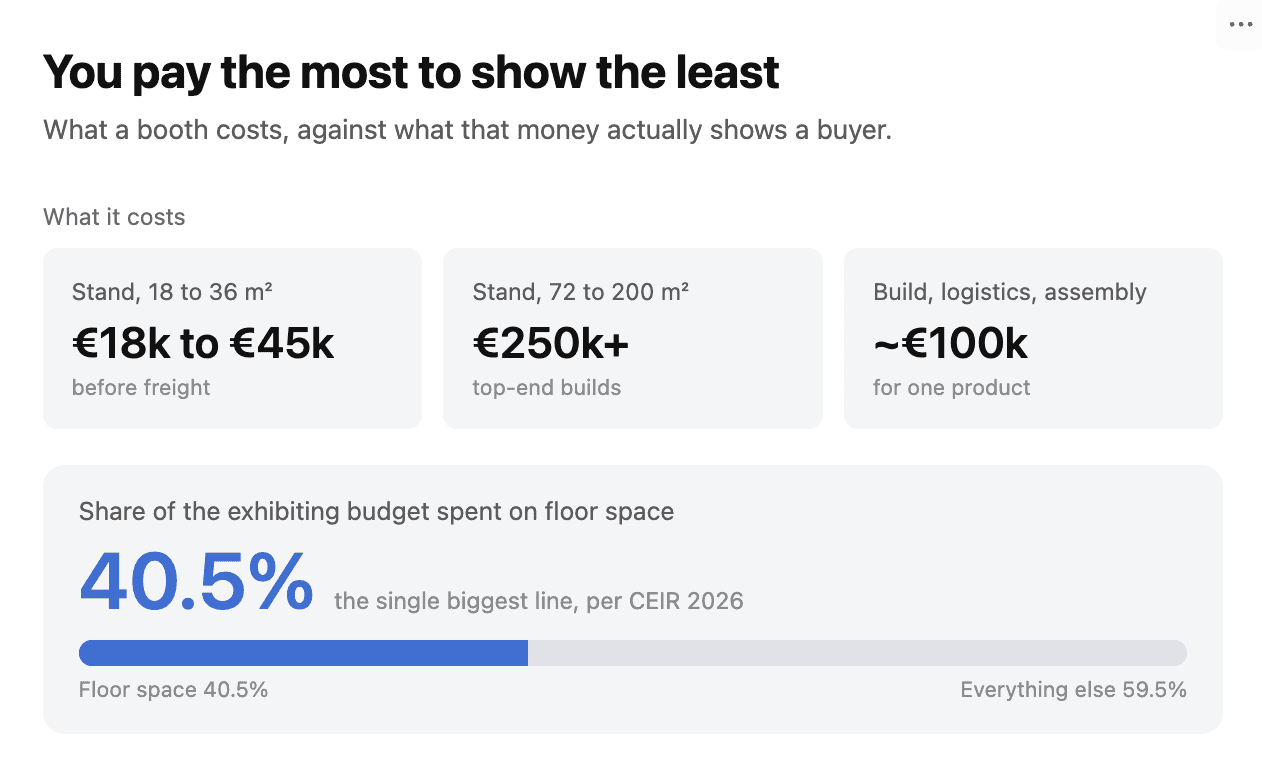
    1. The product does not fit. What a manufacturer sells is often far too big for any booth. A single production line can fill half a plant, and one machine can weigh five tons. But the trade show offers thirty square meters of rented floor at a high price. Exhibit space is the single largest line in the entire exhibiting budget: for U.S. B2B shows it accounts for 40.5% of an exhibitor’s total spend, more than any other category. At Hannover Messe (Germany), a modest 18 to 36 square meter stand costs €18,000 to €45,000, and a large one, 72 to 200 square meters, can pass €250,000. The equipment was never built to be lifted onto a stand, so a company pays the highest price in its budget for the one thing that still cannot hold the product it came to sell.
    2. Shipping machinery is expensive. The heavier the machinery, the higher the sales costs. Transportation, on-site assembling, and travel expenses can run into six figures per event. On average, construction, logistics and assembly add up to around €100,000 to get a single product onto the floor, and the largest, most impressive machines, the ones a company most wants buyers to see, are precisely the ones that push that figure highest.
    3. Buyers see a sample, not the range. Manufacturers have to choose which models to bring, and buyers never see the full portfolio. They are also limited by demo capabilities: system flow, scale, and engineering remain hidden.
    4. The value is hidden under the housing. Much of what a manufacturer charges for happens inside the machine, out of sight. Visitors stand in front of a closed housing and see only the outside of a product whose real engineering is sealed away.
    5. There is no context. Buyers need to understand how it fits into their own production line, works with existing equipment, and supports their process. That context cannot be brought to the booth, so much of the product’s value has to be imagined.
    6. The product may not exist yet. Sometimes the product a company needs to sell is still on the roadmap, or only half-built in a workshop. Industrial sales cycles are long, and buyers often need to commit before a machine physically exists.
    7. You are competing for the same buyer as everyone else. A trade show gathers the entire industry into one hall, which means every rival is only a few steps away. At IMTS 2024, visitors had to work through 1,737 exhibitors spread across more than 1.2 million square feet. Hannover Messe 2025 was larger, with 3,694 exhibitors from 62 countries and more than 123,000 visitors. In a room like that, you have to stand out to get noticed.
Trade show stats

How 3D solves each problem

So, how can 3D visualization help?

Problem: The product is too large to ship, or it does not exist yet.
With XR, prospects can walk around a full-scale model of a product, explore different options for an engineered-to-order build, and see exactly what they are buying months before the first unit is produced. This can shorten the sales cycle. The format changes, but the product remains in front of the customer.

Problem: Shipping and floor space eat the largest share of the budget.
Extended Reality replaces the heaviest line items in the industrial sales budget with a single portable asset. Each of the costs for equipment transport, exhibition stand rental, assembly crew, technical team travel recurs with every event. Over a year, they compound into one of the largest budget lines in industrial sales. A 3D model is created once and can be presented on a screen, in AR, or in VR using equipment that occupies only a small part of the stand. It can be updated when the product line changes and redeployed without additional logistics.

Problem: A physical demo can show only one configuration.
Let each visitor build their own version. For configurable machines built to order, each customer can preview their exact configuration in detail rather than a generic prototype. A configurator on a touchscreen, or the same system in AR or VR, lets them choose components and options, see the result update instantly, and leave with a build that matches their plant. One asset covers all two hundred configurations in the catalog.

Problem: The most important parts of the product are hidden inside.
Exploded views, cutaways and animations show what happens beneath the surface. On a screen, a visitor grasps how the system works within seconds; in AR or VR, they can pull it apart and study the internals in detail. 

Problem: Buyers can’t easily picture how the product fits their own plant.

VR can put a buyer inside a virtual production line. AR can drop the equipment at full scale into the room right in front of them, so they can walk around it. This way, they can see how it fits their facility instead of guessing.

Problem: You have a few minutes to catch attention, and competitors are right next to you.

Big screens with motion are visible from across the hall and pull people toward the stand. Once someone stops, that same 3D does the real work: in a few seconds they see what the machine is and how it runs. You get both the attention and the understanding in the short time a visitor actually gives you.

Problem: Buyers want to explore on their own, but still have an expert nearby.
A trade show makes both possible at once. Visitors interact with the product at their own pace, while technical staff stay within reach for the moment a real question comes up. The trend runs this way: Gartner found in 2026 that 67% of B2B buyers now prefer a rep-free experience, up from 61% a year earlier.

How Virtual Showrooms change trade fair game

Trade fairs are especially cost-intensive for machine manufacturers because transporting, installing, and presenting large equipment requires significant budget and planning. Digital sales solutions address these cost challenges providing stronger engagement, clearer product communication and sales outcomes.

VR showrooms

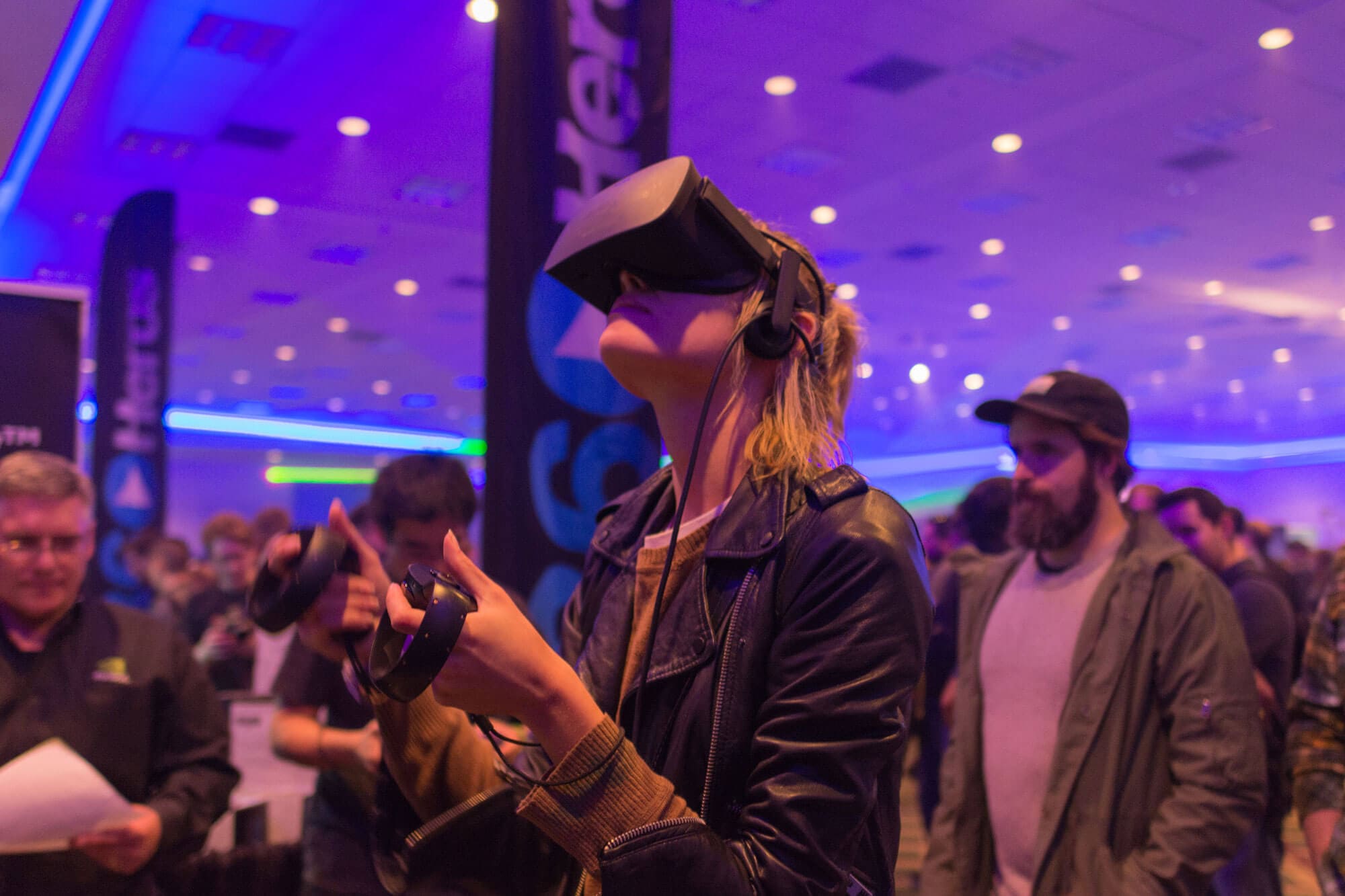
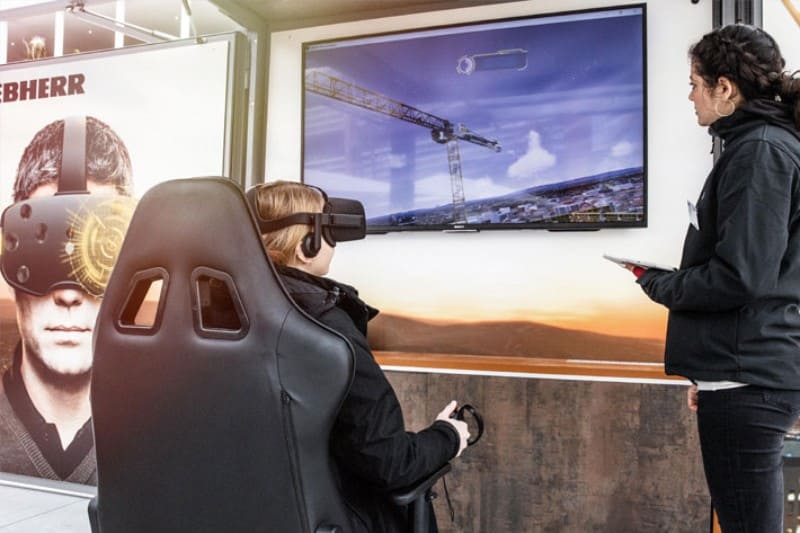
VR showroom is a fully immersive virtual environment where the prospect experiences industrial equipment at real scale. Using a VR headset, the user finds themselves standing next to the machine. They can walk around it, lean in to inspect individual components, and interact with the equipment directly.

The key difference from any other presentation format is depth of access. The user can trigger a working cycle animation and watch the machine operate from the inside: transparent casing reveals the movement of parts, flow of materials, and mechanical sequences that remain invisible on a physical machine. Configurations, attachments, and modules can be switched in real time, allowing the prospect to explore dozens of variants in a single session.

The experience can be adjusted per audience, so engineers, production managers, and procurement each see the information most relevant to their role.

Photorealistic interactive 3D technologies for Virtual Showrooms help sales and marketing teams close long-standing gaps and reduce demo friction. They make complex machines easier to present, improve engagement, support customer training, and help generate leads.
VR Showrooms for trade shows

3D machinery catalog

Machinery сatalog is an XR application that gives the prospect access to the full product range in a single session.

The feature set is fully customizable according to the company’s sales strategy. The user navigates through the product library, picks a specific machine from the catalog, and examines it in 3D at real scale. They can rotate it, walk around it, zoom into specific areas, and switch between products without interruption. They can also toggle optional modules on and off, swap attachments, adjust color schemes, etc. Technical specifications, dimensions, and performance data are displayed alongside the model. 

This more interactive product experience lets buyers quickly explore different options and compare dimensions, designs, and layouts in ways that printed catalogs and PDFs can’t.

Web3D

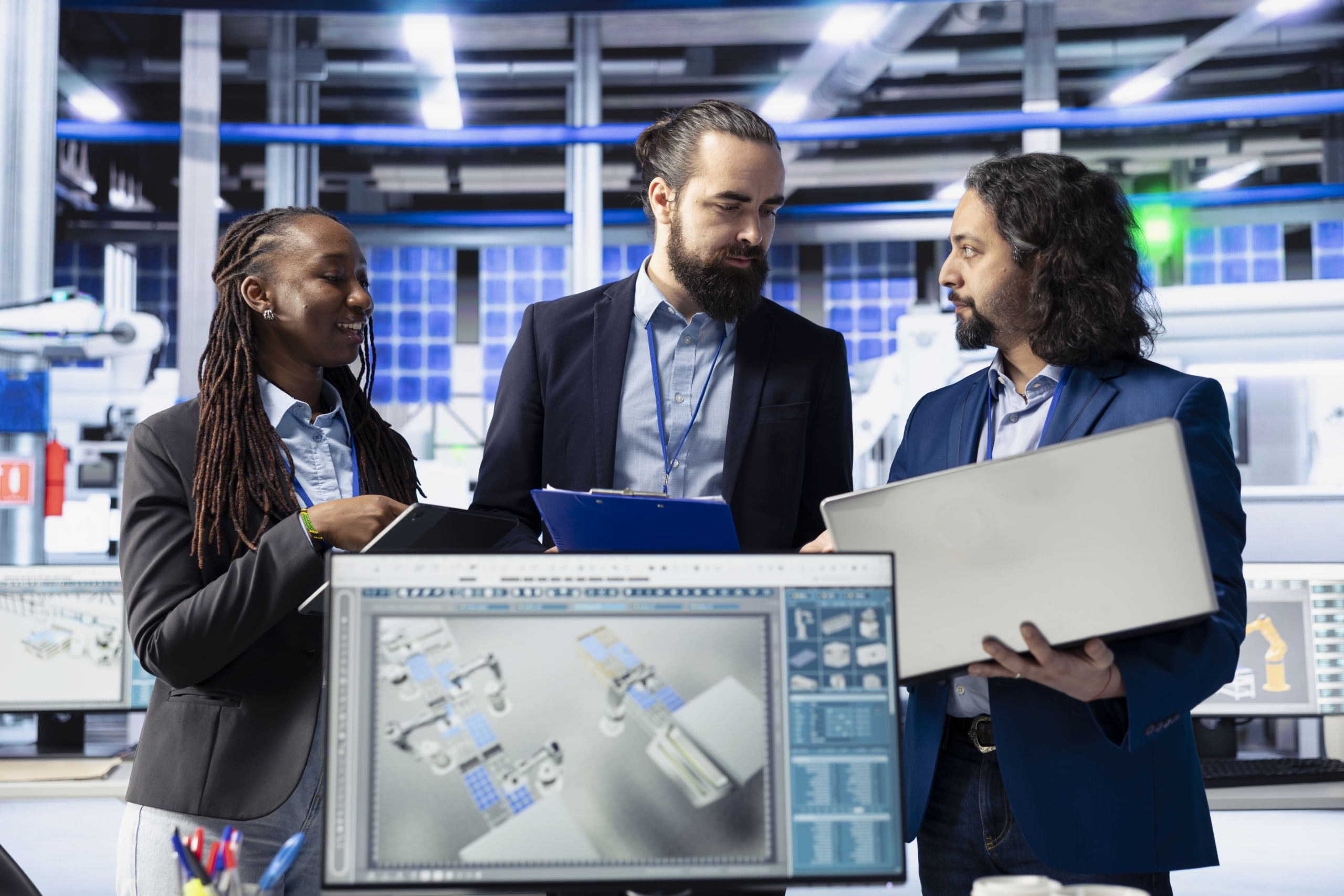
The same model in a browser, opened from a printed handout or a stand graphic, with nothing to install. The viewer shows a photorealistic model that users can rotate, zoom in on, and explore at their own pace. Interactive elements in the Web3D showroom let them highlight key components, learn more about specific parts, and switch between basic configuration options.

This is the format that keeps working after the show closes. In B2B the person standing at the booth is rarely the one who signs, and this is what reaches the engineer, the plant manager or the finance director who never came. It also replaces the printed catalog and becomes the asset the sales team uses in proposals for the rest of the year. Moreover, for manufacturers, every interaction reveals product views, engagement time, and areas of interest.
Web3D for trade shows

Augmented Reality is a “lightweight solution”

Augmented Reality (AR) technology offers a more accessible way to demo machinery when a full VR or XR headset experience is not required or available. Using a phone or tablet, sales teams can place a full-scale 3D model of the equipment directly into the real environment: on the booth floor, in a showroom, inside a factory hall, or later at the customer’s own site.

This makes AR especially useful for quick, practical visualization scenarios. Buyers can see how the machine looks at true scale, and evaluate footprint without putting on a headset or waiting for a full immersive demo. AR’s strongest value is scale and context. Reach, footprint, clearance, access space and other specs are difficult to judge from a spec sheet or static render, but costly to miscalculate. Seeing the machine at full size helps answering these questions immediately.

Product animation on a large screen

The simplest format, and the one that earns the others a chance. A short loop of the machine or the whole line running: material going in, the process working, the product coming out. No interaction, no staff needed, plays all day. Its only job is to stop someone from ten meters away and make it obvious what they’re looking at before they read a single word.

Qualium Systems builds exactly these solutions for manufacturers: VR showrooms and virtual product catalogs, AR at full scale, and WebXR experiences that open in a browser.

What actually works

The booths people remember are not the ones with the biggest budgets. They are the ones that help visitors understand the product quickly and naturally. Here are five practical lessons:

  1. Build the booth around how the product works

The booth is becoming a space built around what the product does. Instead of a machine sitting in the middle of a carpeted square, the layout walks people through the process: what goes in, what happens inside, what comes out, and how it all fits into a real plant. Now, the machine is a part of a walkthrough visitors can follow.

Budgets confirm the direction. EventTrack found that 74% of Fortune 1000 marketers planned to increase experiential spending. The industrial shows show the same move. BAUMA 2025 ran under the motto “Hands on the future,” with manufacturers presenting autonomy and drive technology.

  1. Know the difference between a digital twin and a 3D presentation

This is the distinction most manufacturers get wrong, and the one that wastes the most budget. A digital twin monitors and predicts the state of one specific physical machine: its performance, its wear, its failure points. It is fed by live sensor data and it exists to answer operational questions about a unit that is already installed and running. A 3D presentation has a different job: it explains how a machine works and how it fits into a system, to someone who has never seen it before.

A twin is valuable for existing customers, service contracts and uptime commitments, where the buyer already owns the machine and cares about what it will do next month. A 3D presentation is for the prospect who does not yet understand what the machine is.

At Hannover Messe 2025, exhibitors ran expensive booths with live-data dashboards that visitors could not decode. A trade show needs an explanation that lands in under a minute. Spend on the one that communicates, and keep the twin for the customers who have earned the right to care about it.

  1. Build one asset, use it at three depths

The best programs build one 3D model and reuse it everywhere. Same model, different levels of engagement.

On a big screen, it’s just a loop. It plays with no sound and no explanation, and it has to read from across the hall. You’re not explaining the product at this stage. You just want them to slow down.

At the stand itself, the model does more. Put it on a tablet or in a headset and people can actually handle it: open the housing, swap a configuration, drop it into a plant layout to see how it fits.

Then there’s the part people forget about. Print a QR code on the handout and the model goes home with them. This matters more than it sounds, because in B2B the person you talked to usually can’t sign off on anything alone. There’s an engineer somewhere, or a finance director, who never came to the show and will decide half of it. If they can open the same model on a laptop a week later, the booth is still doing its job. If they can’t, you’re relying on whatever your visitor remembered to tell them.

  1. Let the screen start the conversation

The goal is not to replace people. CEIR’s research is clear that staff remain the most valued part of a booth: 83% of attendees prefer engaging with sales and marketing staff, and 79% with technical product experts. Interactive displays move visitors past the basic question of what the machine does, so the conversation can start at the level that matters: whether it fits their process, their line, their throughput.

There is a practical benefit here as well. A stand has a limited number of experts and a limited number of hours. When the screen handles the introductory explanation, staff spend their time on qualified conversations, and the visitors who do approach arrive already knowing what they are looking at.

Gartner’s data points the same way. Buyers want to explore on their own, but they still come to sellers to validate what they have found. A trade show is one of the few places where both happen in the same few minutes.

  1. Let the medium signal the engineering

Attendees do not evaluate the booth and the product separately. 44% say a booth’s visual quality directly shapes how they judge the product itself, and CEIR’s engagement research shows the same preference in what visitors actually want to interact with: 75% value interactive product displays.

At trade fairs, immersive technologies naturally attract attention. Once engaged, buyers tend to spend more time exploring the product, trying different configurations, and understanding how it works. This can lead to better conversations and more qualified leads, as sales teams can see what each prospect explored and what caught their interest.

It also gives the brand a more innovative image, which matters to a B2B audience increasingly used to digital tools. Independent research supports both effects: people who actively engage with a brand at an event are more likely to buy, while immersive formats can also improve how much of the product story they remember.
Virtual Showrooms

Conclusion

3D visualization isn’t about making the booth look more impressive. It’s there for the times the product can’t be. A machine that never fit on a truck can still be opened up, configured, and dropped into the buyer’s own plant.

What this looks like in practice: one model, built from the CAD data the manufacturer already has. Then you package it for the job. An animation to catch people walking past. An interactive version they can open and configure at the stand. AR or VR when scale is the whole point and a screen won’t convey it. And a plain browser version for the people who decide but never showed up.

Looking to future-proof the way your company sells? Qualium Systems builds Virtual Showrooms that reduce costs, significantly improve product engagement and enable effective trade fair sales. Get in touch and let’s talk about what your booth needs.

Latest Articles
Industrial Trade Shows: 3D Visualization Is Changing the Game
August 20, 2026
Industrial Trade Shows: 3D Visualization Is Changing the Game

Next-generation Extended Reality tech is raising the standard for industrial 3D visualization. Complex equipment becomes much easier to show customers and walk them through, without hauling a physical unit to every meeting. For industrial machinery manufacturers, that’s real business value: by reducing their dependency on physical equipment, companies can improve sales demonstrations and make customer education more visual, scalable, and effective. The value is clear at trade fairs. Industrial machinery manufacturers can usually show only one machine in one configuration. On top of that, the most important parts are often hidden inside, and the product is displayed without the environment it was designed for. So the exhibitor arrives at the show unable to demonstrate the product they’re selling. This is where a new generation of Virtual Showrooms comes in. We’ll look at how it solves that problem below. The problems manufacturers face at trade shows But first, let’s look at the main challenges manufacturers face when relying on traditional trade show methods. The product does not fit. What a manufacturer sells is often far too big for any booth. A single production line can fill half a plant, and one machine can weigh five tons. But the trade show offers thirty square meters of rented floor at a high price. Exhibit space is the single largest line in the entire exhibiting budget: for U.S. B2B shows it accounts for 40.5% of an exhibitor’s total spend, more than any other category. At Hannover Messe (Germany), a modest 18 to 36 square meter stand costs €18,000 to €45,000, and a large one, 72 to 200 square meters, can pass €250,000. The equipment was never built to be lifted onto a stand, so a company pays the highest price in its budget for the one thing that still cannot hold the product it came to sell. Shipping machinery is expensive. The heavier the machinery, the higher the sales costs. Transportation, on-site assembling, and travel expenses can run into six figures per event. On average, construction, logistics and assembly add up to around €100,000 to get a single product onto the floor, and the largest, most impressive machines, the ones a company most wants buyers to see, are precisely the ones that push that figure highest. Buyers see a sample, not the range. Manufacturers have to choose which models to bring, and buyers never see the full portfolio. They are also limited by demo capabilities: system flow, scale, and engineering remain hidden. The value is hidden under the housing. Much of what a manufacturer charges for happens inside the machine, out of sight. Visitors stand in front of a closed housing and see only the outside of a product whose real engineering is sealed away. There is no context. Buyers need to understand how it fits into their own production line, works with existing equipment, and supports their process. That context cannot be brought to the booth, so much of the product’s value has to be imagined. The product may not exist yet. Sometimes the product a company needs to sell is still on the roadmap, or only half-built in a workshop. Industrial sales cycles are long, and buyers often need to commit before a machine physically exists. You are competing for the same buyer as everyone else. A trade show gathers the entire industry into one hall, which means every rival is only a few steps away. At IMTS 2024, visitors had to work through 1,737 exhibitors spread across more than 1.2 million square feet. Hannover Messe 2025 was larger, with 3,694 exhibitors from 62 countries and more than 123,000 visitors. In a room like that, you have to stand out to get noticed. How 3D solves each problem So, how can 3D visualization help? Problem: The product is too large to ship, or it does not exist yet. With XR, prospects can walk around a full-scale model of a product, explore different options for an engineered-to-order build, and see exactly what they are buying months before the first unit is produced. This can shorten the sales cycle. The format changes, but the product remains in front of the customer. Problem: Shipping and floor space eat the largest share of the budget. Extended Reality replaces the heaviest line items in the industrial sales budget with a single portable asset. Each of the costs for equipment transport, exhibition stand rental, assembly crew, technical team travel recurs with every event. Over a year, they compound into one of the largest budget lines in industrial sales. A 3D model is created once and can be presented on a screen, in AR, or in VR using equipment that occupies only a small part of the stand. It can be updated when the product line changes and redeployed without additional logistics. Problem: A physical demo can show only one configuration. Let each visitor build their own version. For configurable machines built to order, each customer can preview their exact configuration in detail rather than a generic prototype. A configurator on a touchscreen, or the same system in AR or VR, lets them choose components and options, see the result update instantly, and leave with a build that matches their plant. One asset covers all two hundred configurations in the catalog. Problem: The most important parts of the product are hidden inside. Exploded views, cutaways and animations show what happens beneath the surface. On a screen, a visitor grasps how the system works within seconds; in AR or VR, they can pull it apart and study the internals in detail.  Problem: Buyers can’t easily picture how the product fits their own plant. VR can put a buyer inside a virtual production line. AR can drop the equipment at full scale into the room right in front of them, so they can walk around it. This way, they can see how it fits their facility instead of guessing. Problem: You have a few minutes to catch attention, and competitors are right next to you. Big screens with motion are…

The State of 3D Medical Image Visualization in 2026
June 29, 2026
The State of 3D Medical Image Visualization in 2026

Today’s imaging systems are more powerful than ever. A single CT scan generates hundreds of cross-sections. An MRI cardiac study captures the heart in four dimensions. A full-body PET produces a dense volumetric map of metabolic activity across every organ system. And yet, in most hospitals today, clinicians consume all of that data the same way they did in the 1990s: as 2D slices, scrolled one frame at a time, with the third dimension reconstructed entirely in the radiologist’s head. That gap between the data that exists and the data that gets used is what 3D medical visualization is closing. Progress hasn’t been uniform. The specialties with the highest spatial stakes have moved fastest. In oncology, where tumour margins and vascular relationships determine whether a resection is safe, 3D visualization is now routine. In cardiology, where structural defects live in three dimensions that 2D echo can only approximate, volumetric review has become standard practice for complex case planning. For these teams, rotating a segmented model or flying through a volume-rendered vessel is part of the reading workflow. Within healthcare, oncology drives roughly 34% of total 3D imaging spend: 52% of cancer centers already use 3D imaging as part of their standard workflow, and 44% of cardiology departments do the same. For much of medicine, the shift is still underway. But the direction is clear. The market reflects it. The global 3D medical imaging market was valued at $21.43B in 2025 and $23.39B in 2026 and is projected to reach $42.75B by 2032  at a compound annual growth rate of 10.36%. Healthcare has become the largest adopter of 3D imaging technology overall. In this article, we break down what 3D medical visualization actually means technically and where it creates measurable clinical value. The imaging data problem Begin with the scanners, because they don’t produce data the same way: CT measures X-ray absorption, so dense tissue like bone reads strongly while soft tissue stays faint: the default for trauma, lung, and skeletal work. MRI reads tissue magnetic properties instead of density, trading speed and bone detail for soft-tissue contrast nothing else matches. PET maps metabolic activity rather than structure, and almost always travels fused to a CT or MRI so the active regions have anatomy to sit against. Ultrasound produces a live volume but depends heavily on probe angle and operator skill. Cone-beam CT gives a tight, high-resolution field at the cost of coverage, which is why it dominates dental and interventional suites. All of these imaging methods capture a 3D volume of the body. Yet in most cases, doctors still review that data as a series of 2D slices. At first glance, this seems surprising: why collect rich 3D data only to view it in 2D? Part of the answer is habit and established workflows, but there are also practical reasons why 2D slices remain the standard in medical imaging. Raw data, nothing interpreted. A slice shows the scan as acquired. Every 3D rendering is the product of decisions which densities to display, which to hide, where to set the threshold and any of those can suppress a real finding or manufacture one that isn’t there. Full coverage of the dataset. Scrolling slices walks the eye across every voxel in the study. A 3D view by definition hides whatever sits behind the surface it shows, and for catching a small lesion or a faint ground-glass opacity, seeing everything matters. 3D earns its place once the task moves past detection: Spatial relationships. 3D visualization makes it easier to understand how anatomical structures relate to one another. Instead of mentally reconstructing anatomy from dozens of 2D slices, clinicians can view organs, vessels, and abnormalities as a single 3D model. Change over time. Tracking changes across multiple scans becomes much easier in 3D. By measuring the volume of a structure over time, clinicians can quickly identify trends that may be difficult to spot in individual slices. Communication. A 3D model is something a patient, a referring physician, or a multidisciplinary team can read at a glance, where a slice stack means little to anyone outside radiology. So, 3D visualization is most valuable when understanding spatial relationships is difficult or time-consuming in 2D. What complicates this in practice is the format the data arrives in. Most medical imaging is still stored as DICOM, a standard built around 2D-image workflows. DICOM is the backbone of medical imaging, but several of its legacy choices make 3D visualization and analysis harder to build on top of it. Gathering everything a full analysis needs is one problem: a careful read of a pathology usually draws on prior scans and the patient’s imaging history, and that data sits scattered across separate studies and series rather than in one place. Interoperability is another. DICOM has to exchange data with the hospital’s other systems, such as PACS, RIS, and the electronic health record, and every connection point adds friction. The input itself is uneven too: scans vary in quality and completeness depending on how and where they were acquired, so a tool built for real cases has to hold up across that range. We’ve written separately about why DICOM is stuck in the ’90s. What “3D medical visualization” actually means There are five techniques in common use. Most clinical software uses two or three of them together. Segmentation comes first, because the others depend on it. Segmentation. Something has to label what is in the scan before the rest can work. It needs to know which voxels are liver, which are tumour, which are vessel wall. This used to be manual work. A radiologist drew outlines on each slice, which for a complex case could take close to an hour. Two radiologists rarely produced identical outlines. AI tools changed this. TotalSegmentator and similar models label most organs in a CT scan in under a minute. The clinician checks and corrects the result instead of drawing it. This is what makes the other four techniques practical for routine use. Multiplanar reformatting (MPR)….

Immersive Storytelling: How XR Turns Audiences from Viewers into Participants
June 8, 2026
Immersive Storytelling: How XR Turns Audiences from Viewers into Participants

Immersive storytelling has moved from experimental format to a working tool used by humanitarian agencies, museums, newsrooms, and brands. The UN commissions 360° productions to communicate field realities. Agog is funding up to $1 million in 2026 grants for immersive climate work. Museums build location-based AR around their collections. Brands replace banner-grade content with VR experiences their audiences actually remember. What unites these use cases is a shift in what audiences expect from a story. Watching is no longer enough. People want to step into the scene, choose where to look, and feel that their presence shapes what happens next. The market reflects this shift. Fortune Business Insights projects the immersive marketing segment alone to grow from $11.66 billion in 2026 to $89.45 billion by 2034, at a CAGR of around 29%. In this article, we look at what immersive storytelling actually means in 2026, the formats producing the strongest results today, why presence works the way it does on a cognitive level, and where the medium is creating the most measurable impact across sectors. What is immersive storytelling? Immersive storytelling is a narrative method built on VR, AR, MR, 360° video, spatial audio, and interactivity. What makes it a distinct medium is the sense of being inside a story rather than watching it from outside. This changes the relationship between content and viewer in three concrete ways. Linear video becomes a 360° scene. Traditional film frames the shot for the audience: the director decides what is in view and what is cut out. In a 360° production, that frame disappears. The viewer chooses where to look, and different details emerge depending on where their attention goes. The same scene can carry multiple parallel observations, and two people watching the same piece may come away with different impressions of what mattered. Text and photography become interactive environments. A written article describes a place; a photo captures a moment of it. Both keep the audience on the outside. Interactive VR and AR let the audience step into the environment, examine objects up close, and in many cases trigger responses through their own actions. Passive consumption becomes an embodied experience. Watching content engages mostly the eyes and ears. Immersive formats add spatial awareness, proprioception, and a sense of physical location. The brain registers the experience closer to how it registers being somewhere in the real world, which is why retention and emotional response measure differently in immersive media than in flat content. How far the experience goes in any of these directions depends on the creative approach. Why it works: The science of presence and empathy When immersive storytelling produces results, it does so through specific mechanisms. The effect it has on audiences has been documented in peer-reviewed research and confirmed by neuroscience. A peer-reviewed study on immersive storytelling and presence found that delivering a story via 360° video on a head-mounted display produces stronger self-location and copresence than the desktop or text version of the same piece. Self-location is the feeling of being physically inside the scene; copresence is the sense of being there with other people. Both have a direct effect on how audiences respond emotionally. Copresence boosts cognitive empathy—the ability to understand what someone else is going through. Self-location and copresence together drive affective empathy—the capacity to share in those feelings. The format is changing what the audience is neurologically equipped to feel. Neuroscience confirms the difference at the signal level. EEG studies comparing VR with television viewing have documented greater mu rhythm suppression during VR sessions—a neural signature long associated with empathic response and mirror neuron activity. The brain registers immersive content differently from flat content. It shows up on EEG equipment, independently of what the audience reports feeling. These findings explain why immersive storytelling is being adopted in fields where emotional connection and behavioral change actually matter: humanitarian communication, climate advocacy, public health, education. But the effect is not automatic. Presence on its own is just immersion. Real emotional and behavioral impact comes from the combination of presence, intentional narrative design, and ethical representation of the subject. Without the second and third, the first is a novelty. Core formats There are five core formats producing immersive storytelling today. They differ in how they are built, how they reach the audience, and what kind of story they can carry. The choice between them is usually the first practical decision in any project. 360° video is the lowest barrier to entry. It is filmed, not built, using specialized cameras that capture the full surrounding scene, which the viewer then explores by turning their head. Production logic is closer to documentary filmmaking than to game development, which makes it accessible to teams already working in video. It is the strongest fit for documentary, fundraising, brand stories, and any project where the goal is to transport the audience into a real place. It is also the most common entry point for organizations producing their first immersive piece. Interactive VR experiences are fully built in engines like Unity or Unreal. Unlike 360° video, the environment is constructed rather than filmed, which means the audience can move through it, interact with objects, and trigger branching narratives. VR development is closer to game development than to film, with longer timelines and higher budgets, but the payoff is depth: the audience can spend hours inside a well-built VR experience and keep finding new layers. This format is the strongest fit for education, simulation, and brand experiences where engagement time matters more than reach. AR experiences anchor digital content to physical locations or objects, delivered through smartphones or smart glasses. The audience stays in the real world and sees a layer of story added on top of it. This makes AR and MR development especially valuable when the physical context is part of the message: a museum exhibit that comes alive when viewed through a phone, a historical site that reconstructs itself on screen, a product that reveals its inner workings when scanned. AR works…


Let's discuss your ideas

Contact us