Virtually Realistic or Reality-Challenged? Unmasking the Graphics Conundrum in Standalone VR Headsets

This article was written by our CEO Olga Kryvchenko and originally published on Linkedin. To get more biweekly updates about extended reality, subscribe to Olga’s XR Frontiers LinkedIn newsletter

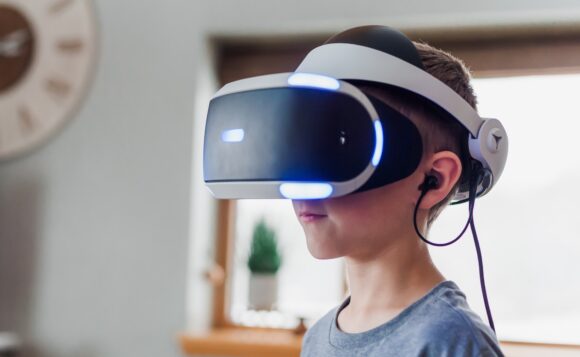
Virtual reality (VR) has been making headlines for ages, and the invention of standalone VR headsets like the Meta Quest 2 and HTC Vive Focus has untethered us from our clunky computers. But there’s one burning question on everyone’s mind: Why do VR apps look like they’ve time-traveled from the 90s?

The culprit? Standalone headsets have to cram all their gizmos, like batteries, processors, and memory, into a fashionable face-hugger. Consequently, they can’t quite flex their graphical muscles like their desktop counterparts.

These headsets come with mobile processors that, bless their hearts, try their best but can’t hold a candle to beefy desktop CPUs. Plus, limited RAM puts a damper on their dreams of breathtaking visuals.

Another hiccup is that standalone VR headsets often sport lower-resolution displays, forcing developers to squeeze out every last pixel of quality. To keep things smooth and enjoyable, they might also prioritize performance and battery life over graphics, resulting in visuals that are more reminiscent of a potato than a Picasso.

Virtual Reality Development

But fret not! There are ways to soup up VR apps for standalone headsets. Just look at Nintendo Switch games, where simplified graphics still spell success. As of December 31st, 2022, the top-selling Nintendo Switch games include Mario Kart 8 Deluxe, Animal Crossing: New Horizons, Super Smash Bros. Ultimate, and The Legend of Zelda: Breath of the Wild. These games prove that less can be more, even when it comes to graphics!

And with WebXR technologies, developers can create virtual experiences for the web that even basic PCs can handle. Take, for example, our WebXR Las Vegas Strip app, which brings the glitz and glamour of Sin City right to your phone/PC – it’s like having your own pocket-sized Vegas vacation!

As tech gets better and better, we’ll soon see standalone VR headsets with graphics capabilities that’ll knock our socks off. In the meantime, developers can jazz up their apps using the tricks up their sleeves, ensuring users have a whale of a time in the virtual realm.

And hey, there’s good news on the horizon! New Qualcomm chipsets and Apple’s M3 generation promise to pack a punch, giving VR headsets the performance boost they’ve been craving. The future of VR is looking brighter by the minute, and soon we might be laughing at the days when standalone headsets struggled to bring our wildest virtual dreams to life.

Image: Unsplash

Latest Articles

cover blog
June 27, 2025
Methodology of VR/MR/AR and AI Project Estimation

Estimation of IT projects based on VR, XR, MR, or AI requires both a deep technical understanding of advanced technologies and the ability to predict future market tendencies, potential risks, and opportunities. In this document, we aim to thoroughly examine estimation methodologies that allow for the most accurate prediction of project results in such innovative fields as VR/MR/AR and AI by describing unique approaches and strategies developed by Qualium Systems. We strive to cover existing estimation techniques used at our company and delve into the strategies and approaches that ensure high efficiency and accuracy of the estimation process. While focusing on different estimation types, we analyze the choice of methods and alternative approaches available. Due attention is paid to risk assessment being the key element of a successful IT project implementation, especially in such innovative fields as VR/MR/AR and AI. Moreover, the last chapter covers the demo of a project of ours, the Chemistry education app. We will show how the given approaches practically affect the final project estimation. Read

Personal efficiency
December 7, 2023
Personal Efficiency vs. Company Efficiency While Working Remotely

Over the past two years, my role as Head of Delivery at Qualium Systems has exposed me to the dynamics of remote work. Remote work is a nuanced topic, with varying perspectives on its advantages and challenges. Some view remote jobs as a liberating solution, offering flexibility, autonomy, and the ability to work from virtually anywhere. However, analyzing the performance of each team member, including myself, in remote work conditions led to a notable revelation. Remote Work’s Positive Impact Discarding ineffective or unproductive employees and focusing solely on dedicated team members resulted in a 15-25% overall increase in efficiency compared to office work. Factors contributing to this improvement include: No wasted time commuting to the office. Less unnecessary chit-chat and idle talk by the water cooler or coffee machine. No need to spend time searching for a meeting room or juggling between different tasks (meetings, colleague questions, etc.). All of this adds up to a boost in personal efficiency. Furthermore, I’ve noticed a positive overall trend: our team members are putting in more work hours than when we were working in person! Navigating Challenges of Remote Collaboration Examining the company’s efficiency during full-time remote work reveals a more intricate situation. While remote work enhances personal productivity, certain processes, such as testing new technologies or conducting internal presentations, become logistically challenging and time-consuming. Read also: 5 Things Project Managers Should Pay Attention To Now, let’s delve into a scenario where we want to try out a new library or technology in a Proof of Concept (POC) format or conduct a presentation demonstration with internal costs. In the offline setting, it’s a straightforward process: Identify an available engineer. Provide the engineer with the necessary devices (glasses, tablet, mobile device, etc.) required for the library, or develop a visual demonstration. Develop, test, and publish the demonstration material. Record a demonstration video and share it on social media. Now, let’s take a peek at how the process unfolds under remote work conditions: Finding Available Engineers: Identifying available engineers remains straightforward. Logistics and Device Distribution: Managing numerous devices for each team member becomes a logistical challenge, requiring extra time for distribution. Increased Meeting Time: More time is spent on 1-2 meetings compared to the initial step. Quality Compromises: The remote setup may compromise the quality of demonstrations or miss certain UX functionalities due to limitations. Video Production Challenges: Recording a demonstration video at home poses technical challenges, potentially affecting the quality or time spent. As you can see, the challenges are evidently more pronounced when it comes to testing new libraries or technologies remotely. Striking a Balance for Maximum Efficiency In conclusion, personal efficiency can thrive in remote work, but company efficiency may face challenges. Striking the right balance involves carefully analyzing company processes and seeking optimal solutions to support collaboration and employee productivity.

close-up-laptop-bed-with-man-bathrobe-background
August 18, 2023
Elevating Hospitality: Evolution of VR in Hotels

Today, modern technologies provide incredible opportunities in numerous areas, including the hotel business. This technology creates a deep connection between the guest and the hotel, overturning the usual idea of hospitality. Virtual reality allows you to surprise guests with immersive unique experiences that are not only exciting but also facilitate the activities of the establishments themselves. In this article, we’ll look at how virtual reality revolutionizes the hospitality industry and helps to deliver unparalleled guest experiences. Exploring Diverse Dimensions of VR in Hospitality There are several main areas where virtual reality is most often used in the hotel industry, including virtual tours, staff training, and VR entertainment.  Enhancing Guest Experiences through VR VR hotel tours are one of the most popular directions where virtual reality is typically when dealing with  hospitality. Before checking in, guests can take a trial visit to the property in VR to assess the hotel environment. This technique will help to better understand where exactly they want to stay, in which room, and whether this hotel meets the requirements. “One of the reasons why VR marketing has taken on a viral tone, arises from the fact, that guests will be provided with a hands-on point of view when making an important booking decision. Using such technology clearly illustrates that the property in question is keeping abreast of the latest digital trends. Today, VR tours can be easily placed on an online platform, through the rise of cost-effective software packages,” according to Keystone Hospitality Property Development. For example, the Atlantis Dubai Virtual Tour shows future customers what the hotel looks like, starting with the exterior and ending with the appearance of the hotel rooms. The experience was filmed in the 360o format. Thriving Frontier of VR Entertainment in Hotels Once your guests have checked into their hotel rooms, they should receive high-quality entertainment offered by the hotel chain itself. These can be virtual reality rooms for guests to spend their free time. For example, the Polish spa resort Czarny Potok also has a virtual reality room where visitors can play various games in VR headsets. In addition, virtual reality can be used as a preview of real entertainment available. Before your guest tries, for example, sightseeing, they can get a preview of a tourist destination they could go to. Consider a VR tour of the ancient city of Petra in Jordan. Read also: Virtual Tours of National Parks. Discovering Nature’s Beauty through AR and VR Navigating Future of Hotel Reservations through VR Another area of virtual reality that is developing in the hotel industry is VR booking. Similar to virtual sightseeing, a user can see the chosen vacation spot for themselves, though the range of possibilities of VR booking is wider.  So, a VR headset user sees a digital globe of the Earth in front of them and decides on the point where they want to go. Next, they interact with a 3D model of the plane, which clearly shows the seats that can be reserved. Moreover, there is an opportunity to rent a car and choose the price of this rental. With virtual booking, users can select a payment method by scanning and adding a digital credit card. Virtual booking from Amadeus IT Group provides such options to users with VR glasses. VR’s Role in Transforming Hotel Staff Training In the hotel industry, virtual reality is used not only to serve customers but also to improve customer service. Virtual reality training, which fully reproduces the real work environment in digital reality, is an effective tool to improve the efficiency of hotel staff. For example, the Best Western Hotels chain recorded a 71% decrease in the number of customer complaints after the introduction of VR training. Virtual training is already used by the famous Hilton network. In this training, employees use VR headsets to immerse themselves in the digital space that reproduces the hotel.There, they perform various tasks typical for the hotel staff: cleaning the room, preparing a cart with lunch, and checking in guests.    The integration of virtual reality marks a revolutionary step towards improving the guest experience and redefining the hospitality industry. With the introduction of virtual reality in hotels, guests are no longer limited by physical boundaries. Virtual tours of hotels and attractions allow them to go on exciting journeys and explore these places without leaving their homes. Once a decision is made, users can completely organize their own trip through VR booking in a gamified form. Virtual reality in the hospitality industry has also paved the way for more comfortable and faster service with the help of VR training for hotel staff. The combination of technology and hospitality has created a new dimension of travel planning where potential guests can virtually walk through hotel rooms, imagine their stay, and make informed decisions. Image: Freepik


Let's discuss your ideas

Contact us