Can the Oculus 2 with Passthrough API take the place of HoloLens 2. Checking the hypothesis
Oculus vs Hololens

After the MRTK library has been adapted to the Oculus Quest 2 and in the ver. 30 of the Operating system we received a pass-through feature, we decided to check if Oculus 2 could be used as an alternative to expensive HoloLens 2. To validate the idea, we’ve made two applications with the same features on the Oculus Quest 2 and on the HoloLens 2. You can see the result in the video at the end of the article.

Short introduction and comparison of headsets OQ2 vs HL2

For those who want to get more information on these devices, we have prepared a small review.
Oculus Quest 2

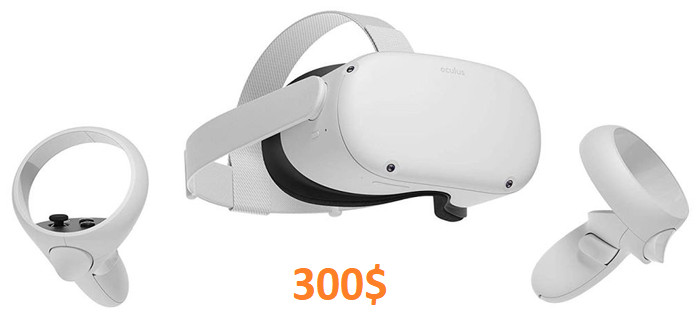
Oculus Quest 2

Oculus Quest 2 is a virtual reality (VR) headset created by Oculus, a brand of Facebook. As with its predecessor, the Quest 2 is capable of running both a standalone headset with an internal, Android-based operating system, and with Oculus-compatible VR software running on a desktop computer when connected over USB or Wi-Fi.

Hardware. The Quest 2 utilizes the Qualcomm Snapdragon XR2 system-on-chip (which is part of a Snapdragon product line designed primarily for VR and augmented reality devices), with 6 GB of RAM — an increase of 2 GB over the first-generation model.

Its display is a singular fast-switch LCD panel with a 1832×1920 per eye resolution, which can run at a refresh rate of up to 120 Hz (an increase from 1440×1600 per-eye at 72 Hz). The headset includes physical interpupillary distance (IPD) adjustment at 58 mm, 63 mm and 68 mm, adjusted by physically moving the lenses into each position. This is also combined with software adjustment.

The included Oculus Touch controllers are slightly bigger, influenced by the original Oculus Rift’s controllers. Their battery life has also been increased four-fold over the controllers included with the first-generation Quest.
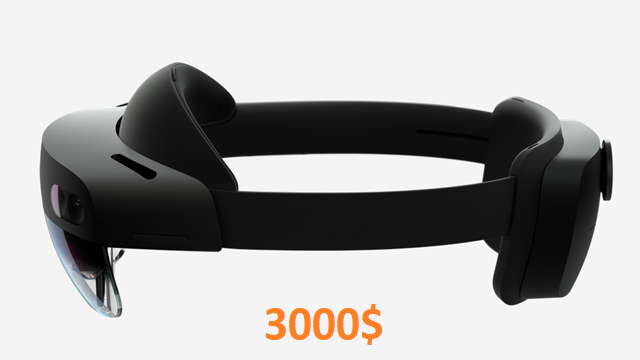
HoloLens 2

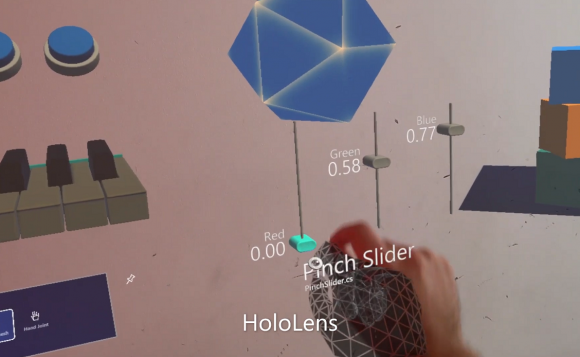
Hololens 2

The HoloLens 2 is a combination of waveguide and laser-based stereoscopic & full-color mixed reality smart glasses developed and manufactured jointly by Microsoft and MicroVision, Inc. in Redmond, Washington. It is the direct model successor to the pioneering Microsoft HoloLens and the technical successor to the MicroVision stereoscopic and monochromatic laser-based virtual retinal display (VRD) & helmet mounted display (HMD) prototype-in-the-running for the canceled RAH-66 Comanche stealth helicopter and the now-defunct monoscopic and monochromatic MicroVision Nomad Augmented Vision System.

Hardware. The HoloLens features an inertial measurement unit (IMU) (which includes an accelerometer, gyroscope, and a magnetometer) four “environment understanding” sensors (two on each side), an energy-efficient depth camera with a 120°×120° angle of view, a 2.4-megapixel photographic video camera, a four-microphone array, and an ambient light sensor.

The HoloLens contains an internal rechargeable battery, with average life rated at 2–3 hours of active use, or 2 weeks of standby time. The HoloLens can be operated while charging.

HoloLens features IEEE 802.11ac Wi-Fi and Bluetooth 4.1 Low Energy (LE) wireless connectivity. The headset uses Bluetooth LE to pair with the included Clicker, a thumb-sized finger-operating input device that can be used for interface scrolling and selecting. The Clicker features a clickable surface for selecting, and an orientation sensor which provides scrolling functions via tilting and panning of the unit. The Clicker features an elastic finger loop for holding the device, and a USB 2.0 micro-B plug socket for charging its internal battery.

HoloLens 2 and Oculus Quest 2 have different operating systems, provide different user experience and have different types of interaction with the system and world.

Development process

Developing applications for Oculus Quest 2 is based on the basic rules and best practices with specific oculus Quest side requirements using Unity engine. If we are talking about HoloLens 2, we have to develop an application for the Universal Windows Platform with specific restrictions and additional capabilities provided by Windows 10 Holographic operating system using the MRTK library provided by Microsoft.

Some time ago we found that the MRTK library has been adapted to the Oculus Quest 2 and we started using it in our projects. This library has a lot of prepared elements that save time for prototyping and development.
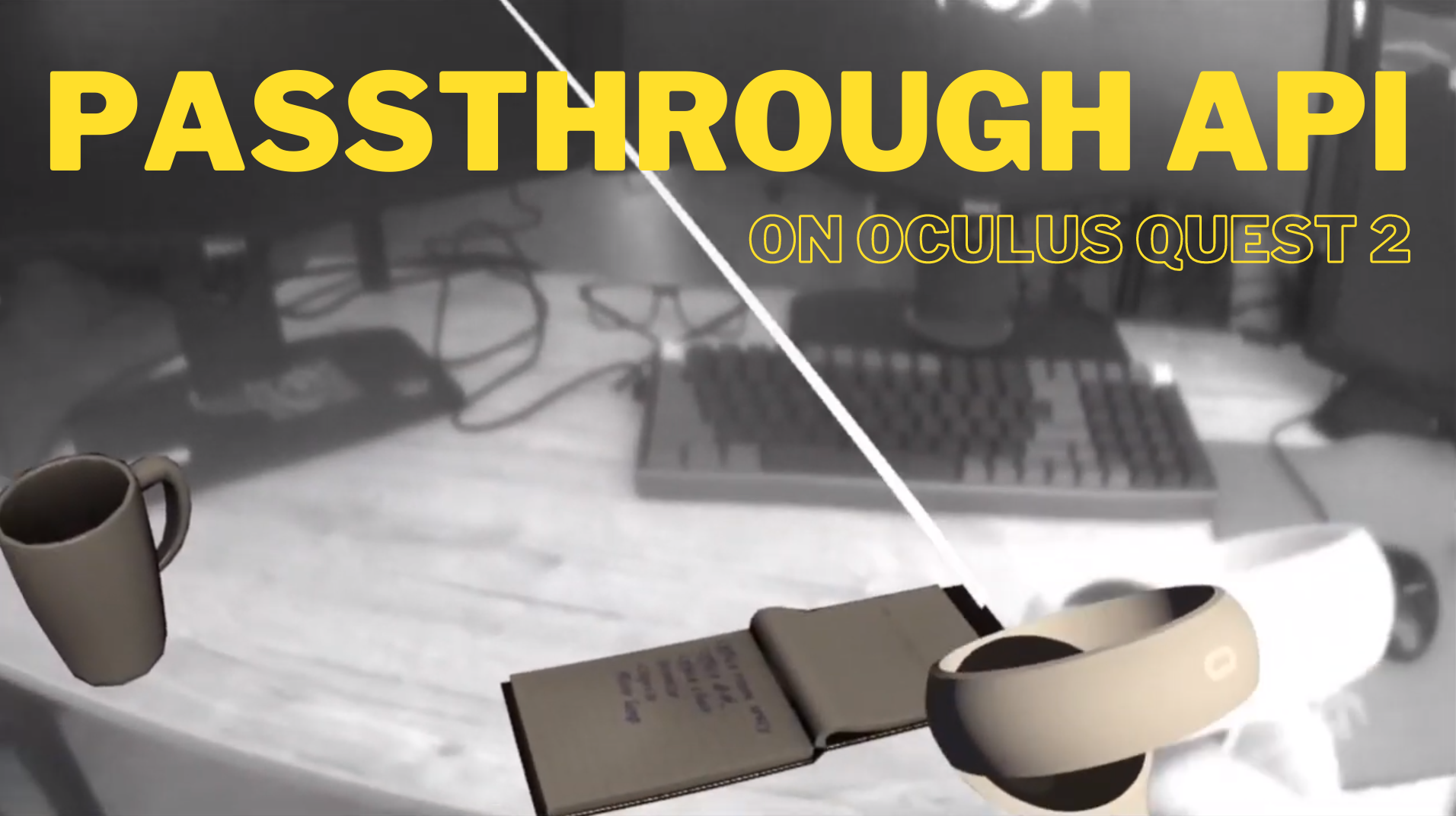
Passthrough API on Oculus Quest 2

In the ver. 30 of the Operating system we received a pass-through feature from Oculus Quest 2 that allows us to step outside your view in VR to see a real-time view of your surroundings. Passthrough uses the sensors on your headset to approximate what you would see if you were able to look directly through the front of your headset and into the real world around you. Taking into account these feature possibilities, we decided to check if Oculus could be used as an alternative to expensive HoloLens 2.

To validate the idea, we’ve made two applications with the same features on the Oculus Quest 2 and on the HoloLens 2. The result you can see in the video.


The summary

Oculus Quest cannot be used as an alternative to the HoloLens for our purpose. The pass-through feature is not the same as Mix Reality. The possibility to work in the real world with Oculus Quest is limited. Also, Oculus Quest has no camera for recognition of images or objects, Oculus Quest doesn’t have lidar or high resolution cameras because Oculus Quest is a B2C product, not a B2B product.

If you have tasks that are suitable for HoloLens 2, use it. Oculus Quest 2 provides some experience of HoloLens 2 usage but these experiences are too limited to make Oculus Quest 2 an alternative to HoloLens 2.

Latest Articles
How Extended Reality Is Reshaping Modern Marketing
March 31, 2026
How Extended Reality Is Reshaping Modern Marketing

The global extended reality market (including VR, AR and MR) is expected to reach $84.86 billion by 2029, growing at an estimated annual rate of 28%. But the bigger point isn’t just that the market is expanding, it’s that XR is already proving its value in the places marketers care about most: engagement, conversion, and customer confidence. In ecommerce, interacting with products via AR leads to a 94% higher conversion rate compared to products without AR. That makes sense: when people can better understand what they’re buying, they’re more likely to move forward and less likely to regret the purchase later.  XR also gives brands something that’s getting harder to win online: attention. VR campaigns generate about 46% higher engagement than traditional digital campaigns. People who interact with AR content spend around 2.7 times longer on product pages.  XR is now showing up in real results. That is why marketing is moving beyond static content toward immersive experiences. In the following sections, we will share how these technologies can be applied to marketing strategies and explore what the future of immersive experiences might look like. How XR is transforming modern marketing: 4 use cases that prove it works With XR, businesses can turn traditional campaigns into fully immersive experiences, where customers can explore products, interact with brands, and connect with content in memorable ways. Its value goes far beyond visual appeal, directly impacting the business growth and customer journey itself. And while this may not be immediately obvious, XR can also save significant resources, reducing the need for physical prototypes, showrooms, or large-scale events, making marketing more efficient. This is why more businesses are integrating immersive technologies into their marketing strategies, even despite certain challenges, such as development and VR hardware costs, as well as complex technology integration. Below, we highlight several successful use cases of immersive technologies in marketing. Virtual try-ons One of the most persistent barriers to online purchasing is uncertainty. Will these glasses suit my face shape? Will this sofa fit in my living room? Will this shade of lipstick actually complement my skin tone? These are questions that traditionally required a physical store visit. Virtual try-on eliminates that leap entirely. The technology behind this falls into a few distinct forms. The most accessible is smartphone-based AR. Customers point their phone at themselves or their surroundings, and the app overlays a true-to-scale digital product in real time. A striking example is the FindYourGlasses app developed by Qualium Systems. A step further are dedicated AR headsets and glasses, which immerse the customer in a mixed-reality environment where products can be explored in even greater depth and spatial accuracy.  These technologies help customers understand what they are buying before making a purchase, enabling them to make decisions based on accurate, personalized visualization rather than guesswork. Real-world example: IKEA Place AR App IKEA Place AR app lets shoppers visualize furniture in their own physical spaces before buying. Customers simply point their phone camera at a room, select a piece of furniture, and see it rendered in realistic scale within their actual environment. This removes the biggest friction point in furniture shopping: not knowing whether a sofa or shelf will actually fit or match the existing interior design. Results: After launch, the app was downloaded millions of times and became one of the most widely adopted retail AR experiences globally. IKEA reported increased customer engagement and reduced returns because customers could see how items fit before purchase. The company reported also that customers who use the IKEA Place app are 11% more likely to complete a purchase compared to those who do not use the app. Virtual showrooms & Tours Some purchases simply feel too significant to make without experiencing the space or context first. Traditionally, that meant showing up in person. Virtual showrooms and immersive tours remove that requirement. The technology here ranges from 360° web-based tours (viewable in any browser without additional hardware) to fully immersive VR experiences delivered through headsets. Visitors can walk through a branded space, interact with products, and access information on demand, without leaving their couch or office. Automotive brands use virtual showrooms to let buyers explore vehicle interiors, switch trims and colors, and get a feel for the cabin before visiting a dealership. Real estate platforms offer immersive property walkthroughs that let buyers shortlist homes remotely. Hotels and resorts use virtual tours to sell the experience upfront.  The value is especially pronounced in the machinery and heavy equipment sector, where physically demonstrating a product has always been costly: shipping industrial equipment to trade shows, organizing on-site demos, and flying prospects to manufacturing facilities all consume significant budgets. VR removes that overhead entirely: a potential buyer can step inside a virtual factory floor, operate a machine in a simulated environment, and evaluate complex equipment in full detail. Real-world example: Virtual showroom for MAKEEN Energy industrial equipment MAKEEN Energy, a global corporation delivering industrial gas solutions and heavy infrastructure equipment, built a true-to-scale virtual showroom. Using 3D models of their equipment in a virtual environment, they were able to pack their sprawling machinery into a portable VR headset and bring it to any trade fair.  Results: By no longer shipping heavy equipment around the world and reducing travel with virtual product demonstrations, MAKEEN Energy was able to cut logistics costs significantly. The virtual showroom also accelerated complex, multi-stakeholder sales by giving engineers, technicians, and purchase managers across different countries a shared, detailed view of the product. What began as a trade fair tool evolved into a company-wide asset for sales, training, and communications. For industrial businesses looking to adopt XR, Qualium Systems serves as a trusted technology partner, delivering VR and Web3D solutions that simplify the presentation of complex equipment, enhance product understanding, and support more effective digital engagement. Immersive brand storytelling XR gives brands the ability to place customers at the center of a narrative, transforming passive content consumption into a first-person experience that is far harder to forget. A VR film or AR…

June 27, 2025
Methodology of VR/MR/AR and AI Project Estimation

Estimation of IT projects based on VR, XR, MR, or AI requires both a deep technical understanding of advanced technologies and the ability to predict future market tendencies, potential risks, and opportunities. In this document, we aim to thoroughly examine estimation methodologies that allow for the most accurate prediction of project results in such innovative fields as VR/MR/AR and AI by describing unique approaches and strategies developed by Qualium Systems. We strive to cover existing estimation techniques used at our company and delve into the strategies and approaches that ensure high efficiency and accuracy of the estimation process. While focusing on different estimation types, we analyze the choice of methods and alternative approaches available. Due attention is paid to risk assessment being the key element of a successful IT project implementation, especially in such innovative fields as VR/MR/AR and AI. Moreover, the last chapter covers the demo of a project of ours, the Chemistry education app. We will show how the given approaches practically affect the final project estimation. Read

June 27, 2025
What Are Spatial Anchors and Why They Matter

Breaking Down Spatial Anchors in AR/MR Augmented Reality (AR) and Mixed Reality (MR) depend on accurate understanding of the physical environment to create realistic experiences, and they hit this target with the concept of spatial anchors. These anchors act like markers, either geometric or based on features, that help virtual objects stay in the same spot in the real world — even when users move around. Sounds simple, but the way spatial anchors are implemented varies a lot depending on the platform; for example, Apple’s ARKit, Google’s ARCore, and Microsoft’s Azure Spatial Anchors (ASA) all approach them differently. If you want to know how these anchors are used in practical scenarios or what challenges developers often face when working with them, this article dives into these insights too. What Are Spatial Anchors and Why They Matter A spatial anchor is like a marker in the real world, tied to a specific point or group of features. Once you create one, it allows for some important capabilities: Persistence. Virtual objects stay exactly where you placed them in the real-world, even if you close and restart the app. Multi-user synchronization. Multiple devices can share the same anchor, so everyone sees virtual objects aligned to the same physical space. Cross-session continuity. You can leave a space and come back later, and all the virtual elements will still be in the right place. In AR/MR, your device builds a point cloud or feature map by using the camera and built-in sensors like the IMU (inertial measurement unit). Spatial anchors are then tied to those features, and without them, virtual objects can drift or float around as you move, shattering the sense of immersion. Technical Mechanics of Spatial Anchors At a high level, creating and using spatial anchors involves a series of steps: Feature Detection & Mapping To start, the device needs to understand its surroundings: it scans the environment to identify stable visual features (e.g., corners, edges). Over time, these features are triangulated, forming a sparse map or mesh of the space. This feature map is what the system relies on to anchor virtual objects. Anchor Creation Next, anchors are placed at specific 3D locations in the environment in two possible ways: Hit-testing. The system casts a virtual ray from a camera to a user-tapped point, then drops an anchor on the detected surface. Manual placement. Sometimes, developers need precise control, so they manually specify the exact location of an anchor using known coordinates, like ensuring it perfectly fits on the floor or another predefined plane. Persistence & Serialization Anchors aren’t temporary — they can persist, and here’s how systems make that possible: Locally stored anchors. Frameworks save the anchor’s data, like feature descriptors and transforms, in a package called a “world map” or “anchor payload”. Cloud-based anchors. Cloud services like Azure Spatial Anchors (ASA) upload this anchor data to a remote server to let the same anchor be accessed across multiple devices. Synchronization & Restoration When you’re reopening the app or accessing the anchor on a different device, the system uses the saved data to restore the anchor’s location. It compares stored feature descriptors to what the camera sees in real time, and if there’s a good enough match, the system confidently snaps the anchor into position, and your virtual content shows up right where it’s supposed to. However, using spatial anchors isn’t perfect, like using any other technology, and there are some tricky issues to figure out: Low latency. Matching saved data to real-time visuals has to be quick; otherwise, the user experience feels clunky. Robustness in feature-scarce environments. Blank walls or textureless areas don’t give the system much to work with and make tracking tougher. Scale drift. Little errors in the system’s tracking add up over time to big discrepancies. When everything falls into place and the challenges are handled well, spatial anchors make augmented and virtual reality experiences feel seamless and truly real. ARKit’s Spatial Anchors (Apple) Apple’s ARKit, rolled out with iOS 11, brought powerful features to developers working on AR apps, and one of them is spatial anchoring, which allows virtual objects to stay fixed in the real world as if they belong there. To do this, ARKit provides two main APIs that developers rely on to achieve anchor-based persistence. ARAnchor & ARPlaneAnchor The simplest kind of anchor in ARKit is the ARAnchor, which represents a single 3D point in the real-world environment and acts as a kind of “pin” in space that ARKit can track. Building on this, ARPlaneAnchor identifies flat surfaces like tables, floors, and walls, allowing developers to tie virtual objects to these surfaces. ARWorldMap ARWorldMap makes ARKit robust for persistence and acts as a snapshot of the environment being tracked by ARKit. It captures the current session, including all detected anchors and their surrounding feature points, into a compact file. There are a few constraints developers need to keep in mind: World maps are iOS-only, which means they cannot be shared directly with Android. There must be enough overlapping features between the saved environment and the current physical space, and textured structures are especially valuable for this, as they help ARKit identify key points for alignment. Large world maps, especially those with many anchors or detailed environments, can be slow to serialize and deserialize, causing higher application latency when loading or saving. ARKit anchors are ideal for single-user persistence, but sharing AR experiences across multiple devices poses additional issues, and developers often employ custom server logic (uploading ARWorldMap data to a backend), enabling users to download and use the same map. However, this approach comes with caveats: it requires extra development work and doesn’t offer native support for sharing across platforms like iOS and Android. ARCore’s Spatial Anchors (Google) Google’s ARCore is a solid toolkit for building AR apps, and one of its best features is how it handles spatial anchors: Anchors & Hit-Testing ARCore offers two ways to create anchors. You can use Session.createAnchor(Pose) if you already know the anchor’s position, or…


Let's discuss your ideas

Contact us